Curio 34 Release Notes 📖 

Release Date
September 1, 2026
Requirements
Curio 34 runs on macOS 15 Sequoia through macOS 27 Golden Gate on Apple silicon or Intel.
Feature Availability
Features only available in certain editions will be listed with colored tags, like .
Highlights
Kanban Boards
Create Trello-style boards that automatically group and sort work by priority, rating, tags, start and due dates, and more. Dragging an item between stacks updates its metadata automatically.
Smart Kanban Boards
Curio Professional can build query-backed Kanban boards containing matching items gathered from across your entire project. Edit an item on the board and the changes sync with its original. Drag between priority, rating, or tag stacks to update its metadata.
Table Formulas and Sorting
Curio Professional brings Excel-like formulas with structured column references to both native and Markdown tables, including common math, statistical, and formatting functions. Both Standard and Professional can sort native tables by any column while keeping headers and footers fixed.
Synced Collection Instances
Copy a list, mind map, or stack and paste it as a synced collection in Curio Professional. Text, metadata, hierarchy, ordering, and other changes stay synchronized across every linked instance.
Figure References
The new References panel in Curio Professional lets you attach typed references to figures, linking related evidence and context to Curio jump targets or web locations.
Project Tag Sets
Create tag sets that belong to a specific project, complete with custom colors, ordering, and single-selection behavior. Project tag sets also work as Kanban groupings and throughout Curio’s search and status features.
Curio CLI and MCP
The separately downloaded Curio CLI gives Terminal scripts and AI agents extensive access to Curio’s projects and content. It also includes an MCP server for direct integration with compatible AI clients and is available to Curio Professional sustainers.
Paragraph and Character Text Styles
Create project-wide paragraph and character styles for consistent formatting, then update a style to propagate the changes throughout your project. New kerning, line-height, and paragraph-spacing controls provide even finer typographic control.
macOS Widgets
Put project queries on your Desktop or in Notification Center for an at-a-glance view of matching items, metadata, and tasks. Curio Professional also includes a Status widget that gathers tasks from across your projects.
Shortcuts Automation
Curio now includes native actions for Apple’s Shortcuts app, allowing automations to open projects, find items, read the current selection, navigate, import files, and export content.
Flexible Figure Adornments
Place checkboxes, tags, dates, priorities, ratings, and other adornments in 12 positions around a figure. You can also keep checkboxes in their own left-hand lane while placing the remaining metadata elsewhere.
Smarter Search
Improved relevance ranking puts strong title and heading matches first, while conservative fuzzy matching helps locate items even from abbreviated queries. Query fields also gain autocomplete, note-only searching, and custom-data sorting.
Native Content Search
Curio now extracts and indexes text from PDFs, documents, source files, email messages, and images with OCR—including files embedded inside your project—without relying on Apple’s older SearchKit technology.
Focus for Idea Graphs
Focus mode now understands connected idea graphs, following directional lines to keep downstream figures visible while dimming unrelated content.
Word Counts and Readability
A new status bar module shows live word and character counts, with a detailed popover containing paragraph and sentence totals, readability scores, and sentiment.
Local HTML Figures
Drop a local HTML file into Curio to display it as a live, interactive web figure—perfect for visualizations, dashboards, and other artifacts created with AI tools.
Faster Navigation
Designate a Home idea space and return to it instantly from the navigator. Curio Professional presentations also gain a hierarchical Jump To menu for moving directly between idea spaces.
New Color Tools
Control-click Curio’s color wells to edit colors using RGB, HSL, OKLCH, or OKLAB sliders, or Command-click to sample any color on screen. Lists and mind maps can also generate coordinated branch palettes automatically.
New Features
Kanban Boards
Organize your work with new Kanban boards! Group tasks into stacks by priority, status tags, or dates, then drag them between stacks to update them. Move a task from Low to Urgent to change its priority, from On Hold to Active to change its tag, or into Tomorrow to set its start date.
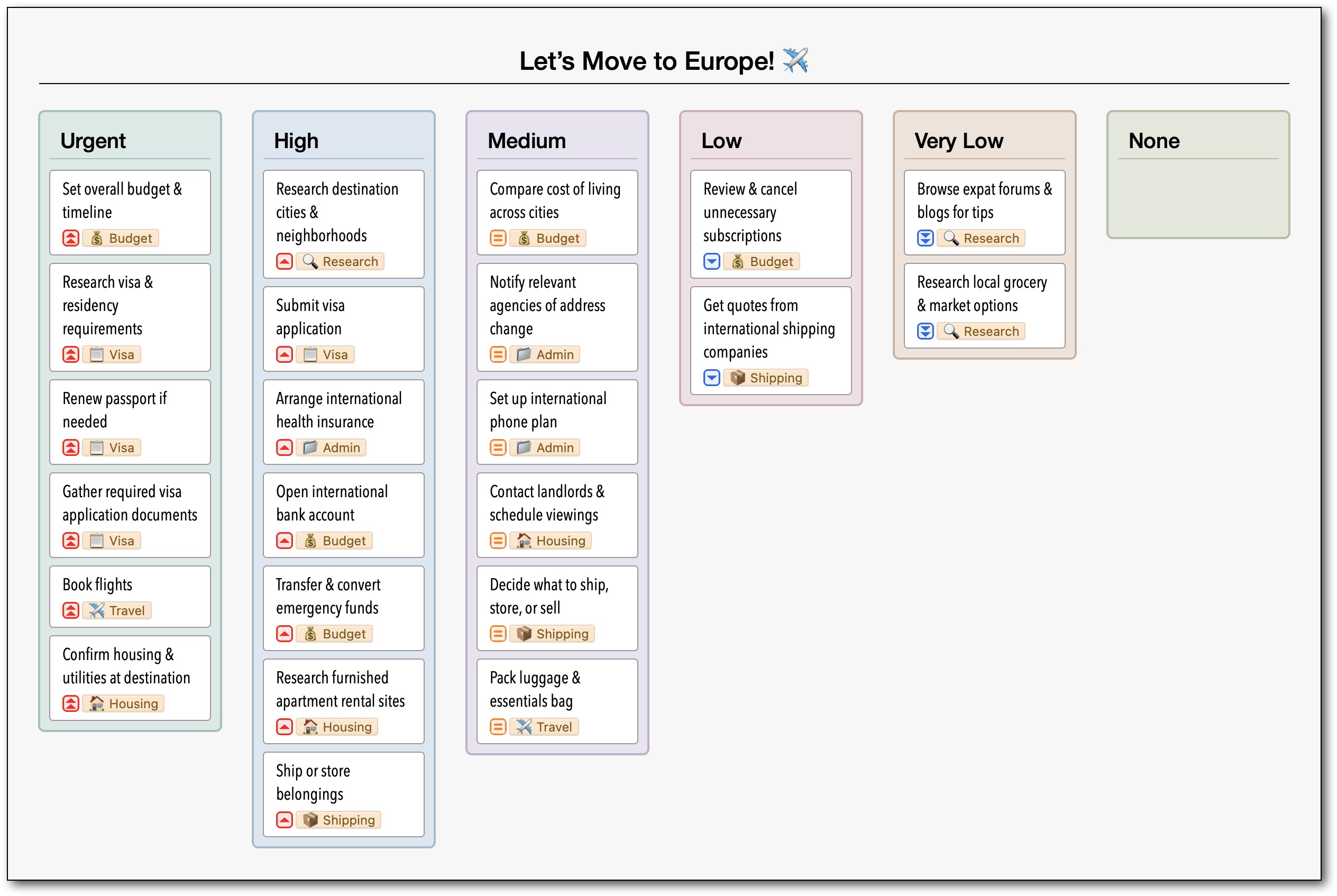
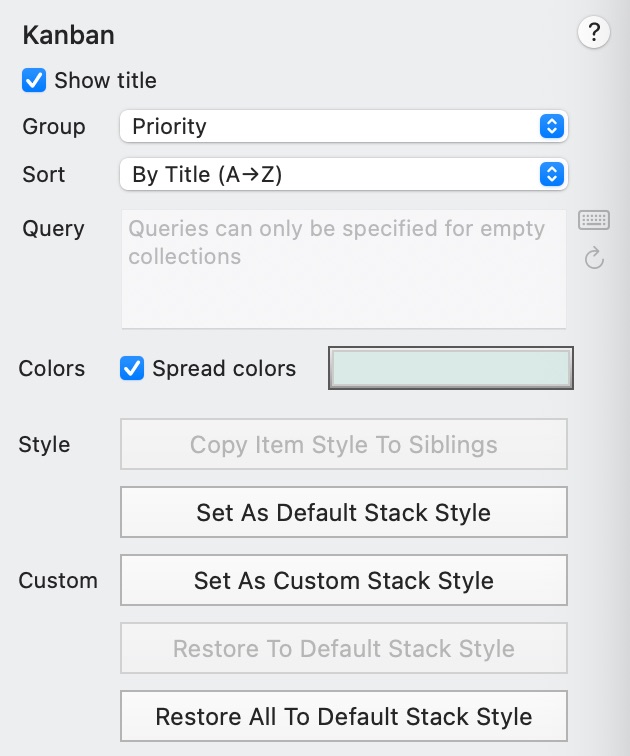
- Group work your way. Choose priority, rating, a single-selection tag set such as GTD, or dates including start, due, and last modified. Curio creates the stacks for you, including a place for items without a priority, rating, tag, or date.
- Keep each stack sorted. Sort by title, action date, start date, due date, percent complete, rating, or priority. Change the grouping or sorting whenever you like and Curio reorganizes your board automatically.
- Update tasks with a drop. Drag a task between stacks—or bring one in from a list or another collection—and Curio updates its priority, rating, assigned tag, or date to match the destination stack, depending on your board’s grouping. You can also double-click a date stack to create a new item with a date that fits. Editing the grouping attribute in the inspector moves the task to the appropriate stack too.
- Make priorities easy to spot. Give each stack its own style—perhaps red for Urgent and cool blue for Low. Curio remembers those styles when you change groupings. Or pick a base color and use Spread Colors to color the stacks automatically.
- New keyboard shortcut. Insert a Kanban board with ⌃⌘K; the Stack shortcut is now ⌃⌘S. In the Insert popover, press
Kfor the Kanban gallery orSfor the Stack gallery.
Smart Kanban Boards
Bring tasks from across your project together on one board! Curio Pro’s new Smart Kanban boards find matching items automatically and keep them synchronized with their originals. Update a task on your board and the change appears wherever that task lives.
- Gather the work you need. Start with an empty Kanban board, choose its grouping and sorting, then enter a query just as you would in Search. Curio fills the board with matching items from your project using synced figure instances. The board refreshes automatically as searchable project content changes.
- Update tasks right on the board. Edit text or drag cards between priority, rating, or tag stacks to update the original items. Tag changes also work for results representing Organizer items.
As an example, let's say we have the following todo list in our project with items tagged from the Paper tag set, priorities, and automatic date rollups.
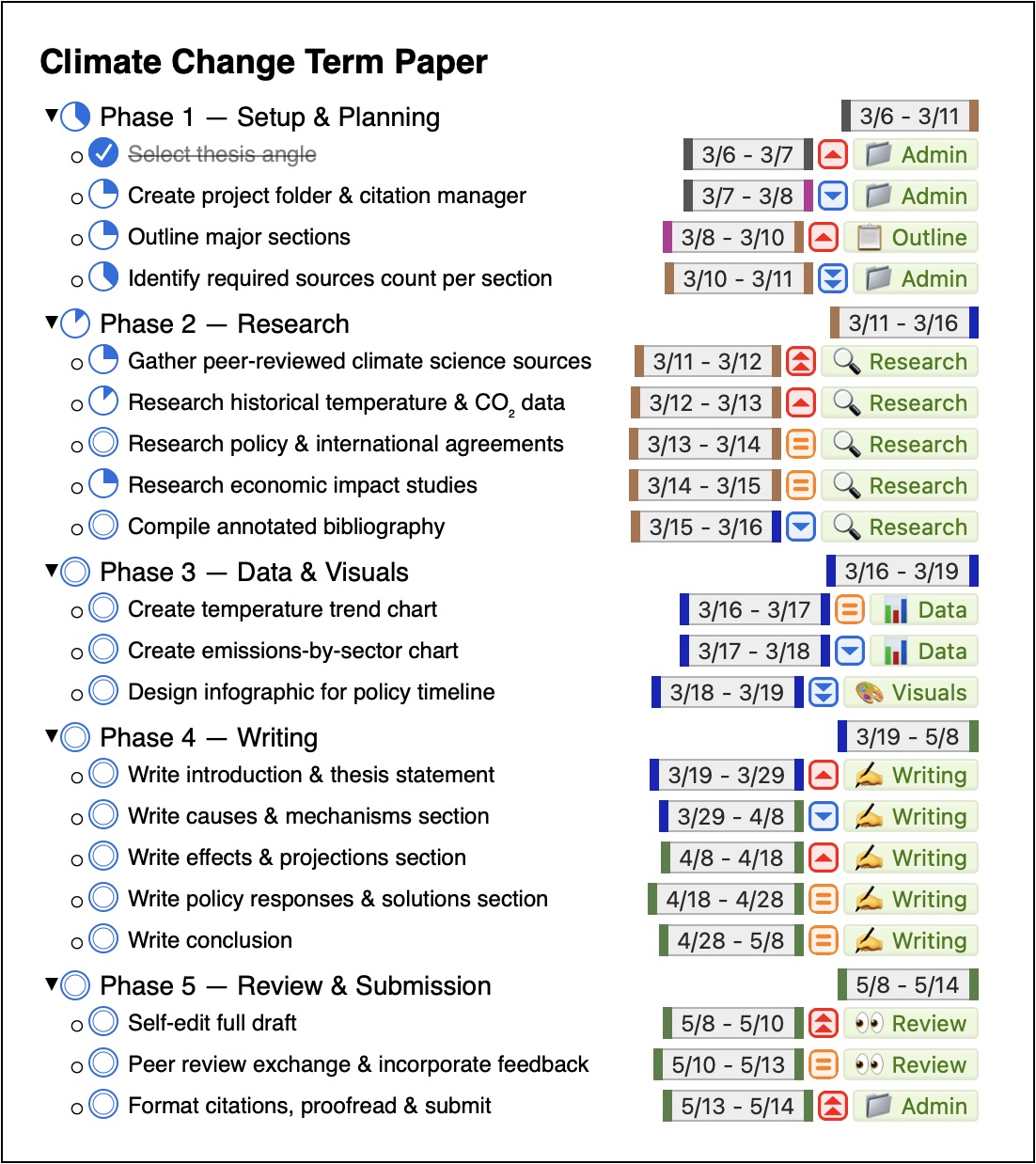
Let's create a Smart Kanban that pulls information from that list via the query #paper. Below we see those same tasks as Kanbans with different groupings (and styles) of that data: Start Date (Colors), Priority (Cello), Paper tag set (Dusk).
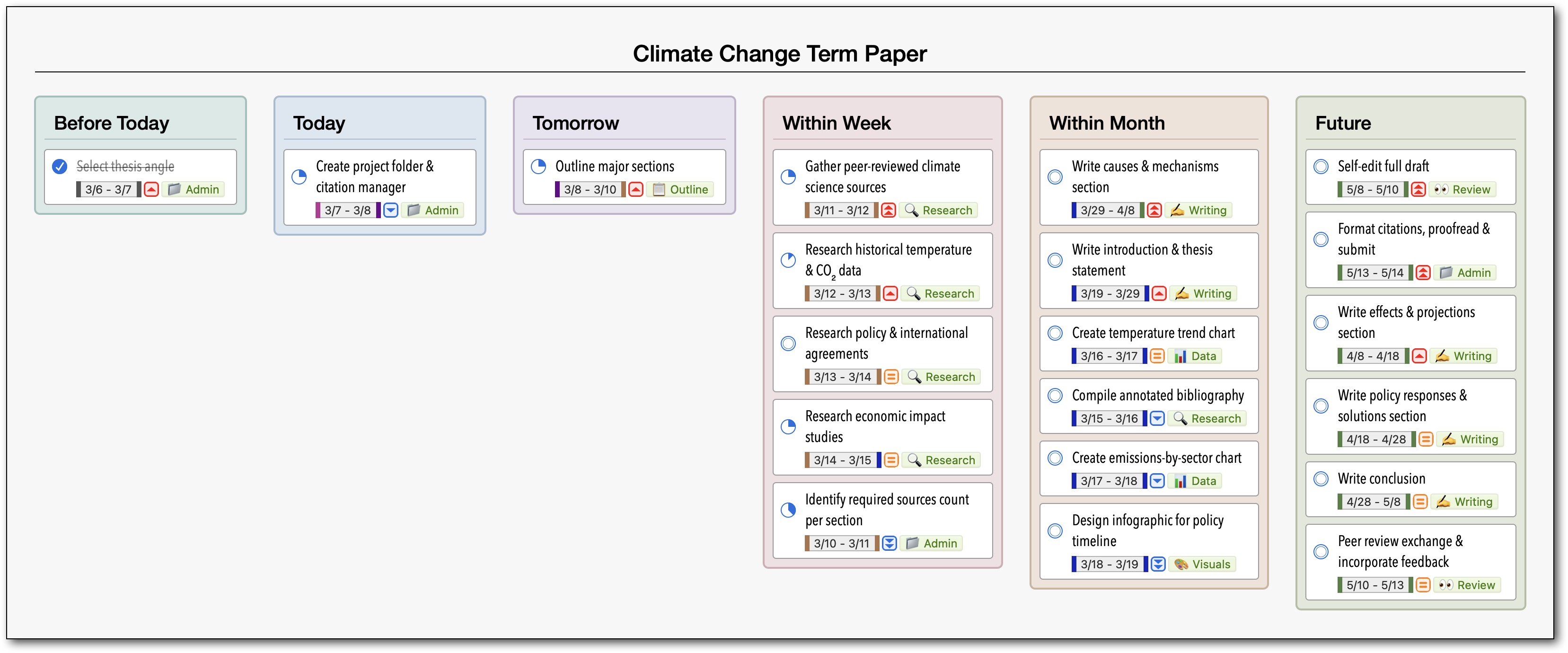
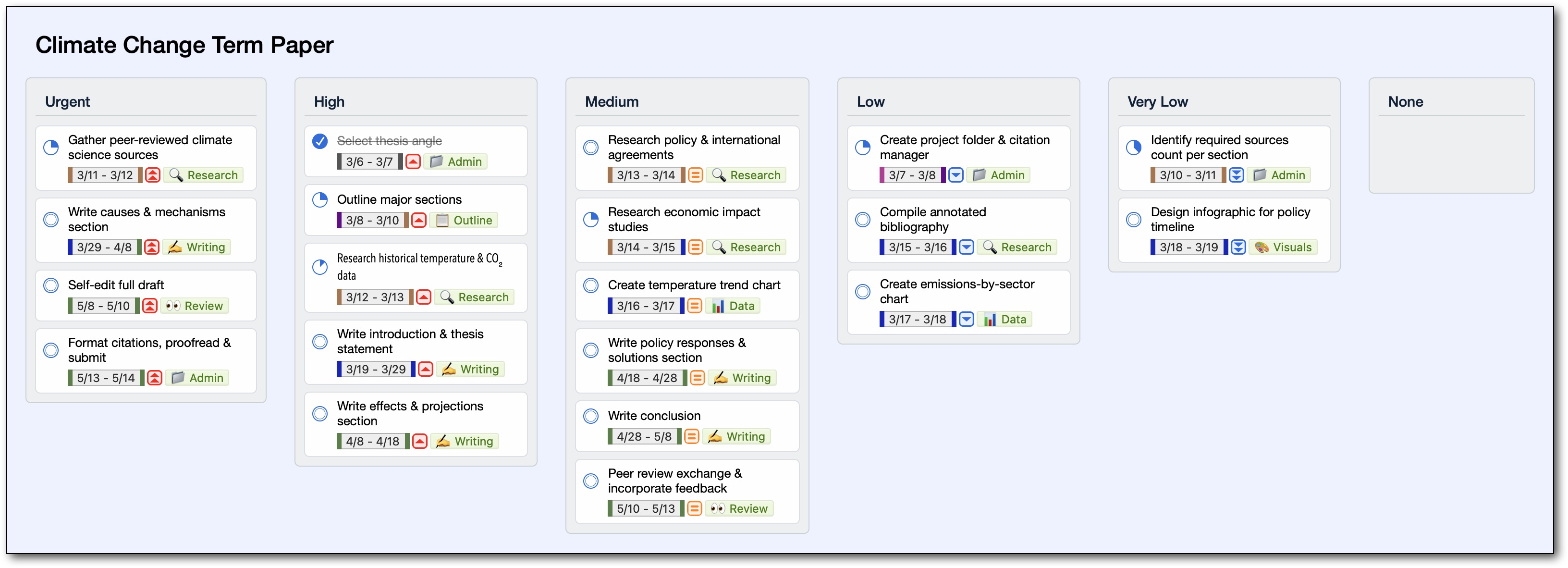
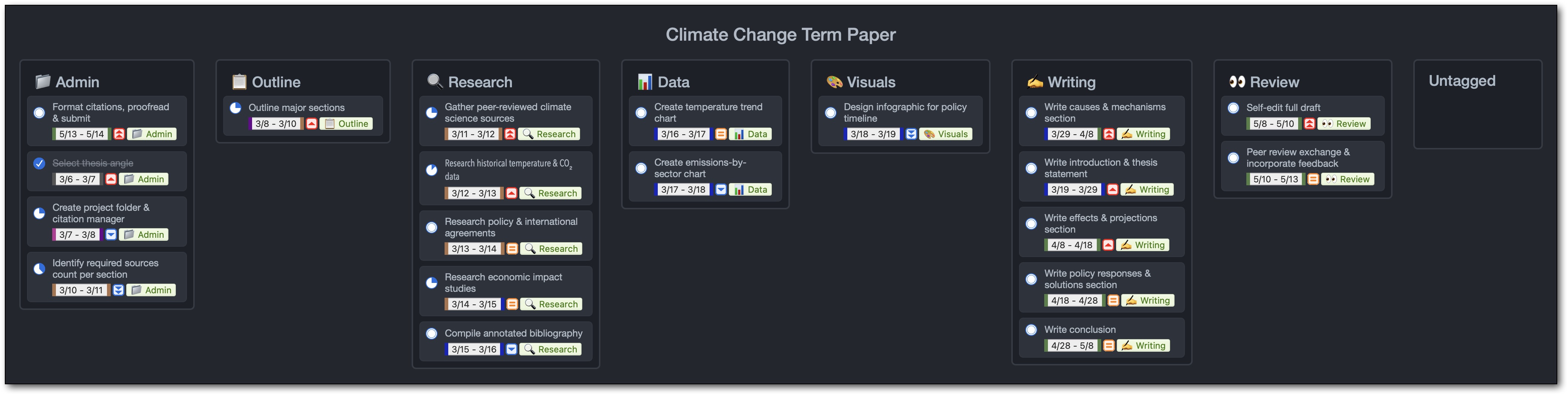
Your query can gather matching items from anywhere in the project, so the board can bring together work from many lists and idea spaces.
Dragging between date stacks isn’t supported on Smart Kanban boards. Use a standard Kanban board to schedule tasks by dragging.
Table Formulas
Your tables can now do the math! Calculate costs, average scores, or total a column directly in Curio Pro. Formulas use your column names, so a calculation like =[@Price]*[@Quantity] is easy to read.
Start a cell with = to display a calculated result. Use [@Column] for a value in the current row or [Column] for an entire column. Along with basic arithmetic and parentheses, formulas include familiar functions for totals, averages, counts, rounding, and number formatting, such as SUM, AVERAGE, COUNT, ROUND, and TEXT.
Give your results the right format using the text inspector: numbers, currencies, percentages, scientific notation, and more. Your formula can stay numeric while Curio handles how the result appears.
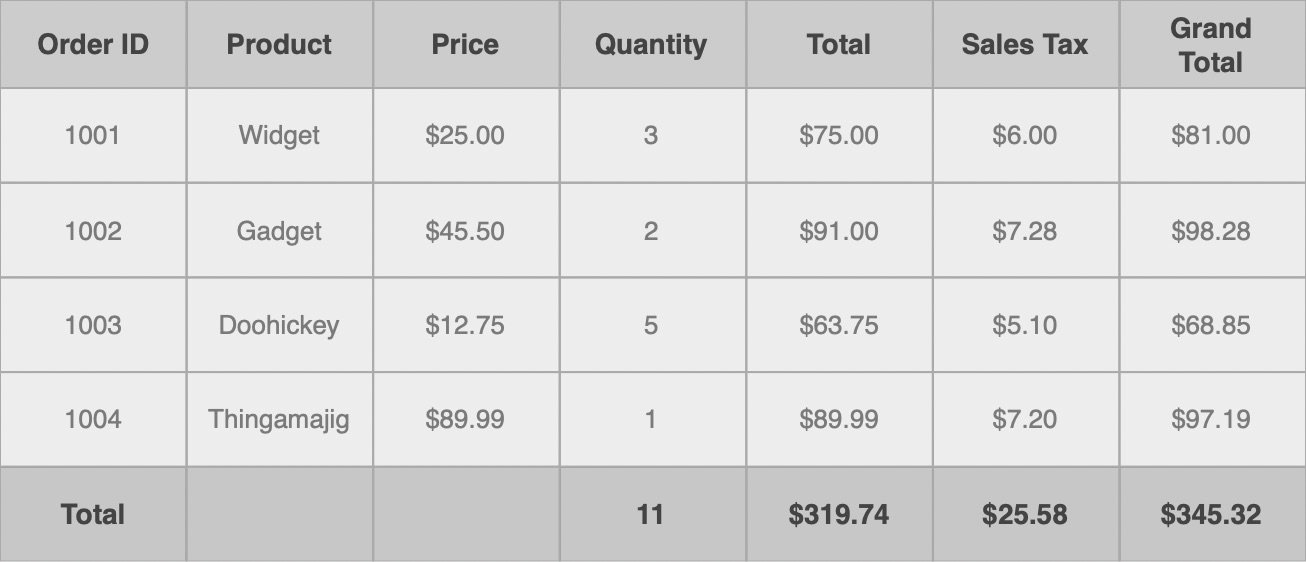
In this table, the row values in the Total column are all =[@Price]*[@Quantity]; notice the @ references the value in the specified column for the current row. The bottom cell in Total is =SUM([Total]) to get the sum of the entire named column. We format it with a numeric formatter chosen from the text inspector.
Markdown Table Formulas
Markdown tables can now calculate their own results in Curio Pro! Build a budget with prices, quantities, and totals, then change a value and watch the calculations update when you finish editing.
Start a cell with = and refer to columns by name: [@Column] for the current row or [Column] for the entire column. Use basic arithmetic, parentheses, and familiar functions such as SUM, AVERAGE, COUNT, and ROUND. The TEXT function formats results as currency, percentages, and more.
Here’s a Markdown table with calculated totals and currency formatting (see the raw Markdown). Curio calculates formulas before styling the table, so multiplication signs work as expected.
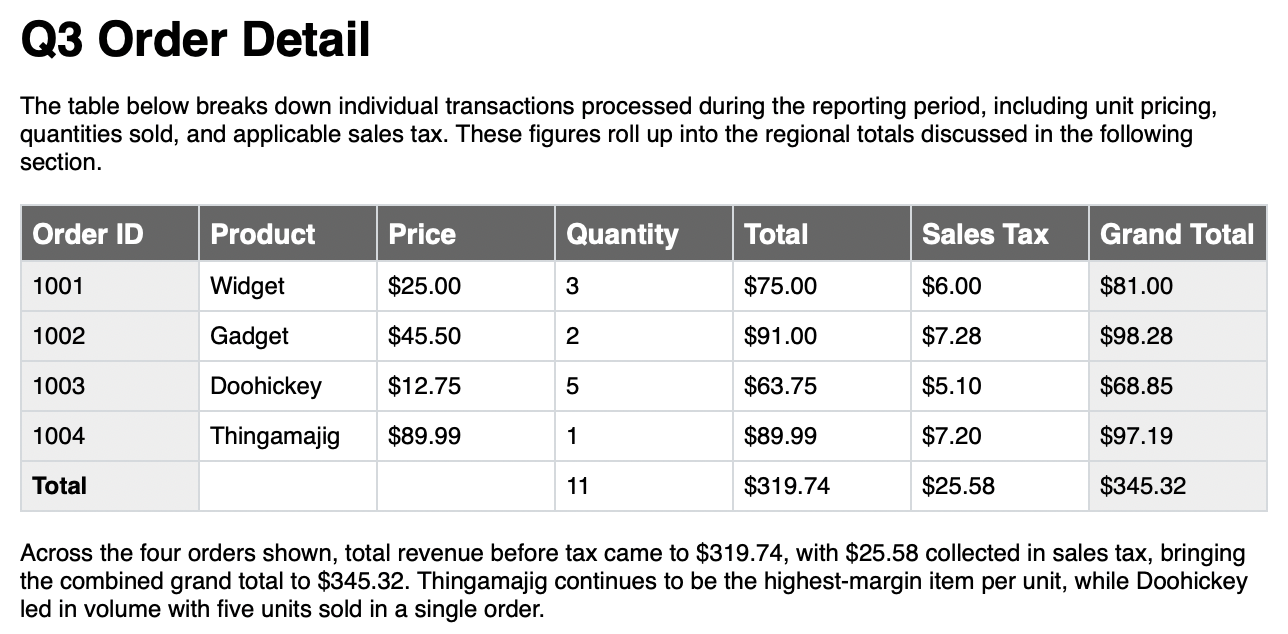
In this table, the row values in the Total column are all =[@Price]*[@Quantity]; notice the @ references the value in the specified column for the current row. The bottom cell in Total is =SUM([Total]) to get the sum of the entire named column. We format it with =TEXT(SUM([Total]),"$#,##0.00").
Table Sorting
Synced Collection Instances
Keep the same ideas together in different places...and different views! In Curio Pro, copy a list, mind map, or stack and paste it as a synced collection. View your outline as a mind map elsewhere in the project, then edit either version and both stay synchronized.
Text, tags, dates, and other metadata stay synchronized, along with the collection’s hierarchy and item order. Keep a working list in one idea space and a synced view in another without maintaining separate copies.
Rearrange, delete, indent, or outdent items in any synced copy and the original and every other copy update too. New items must be added to the original collection.
When a synced collection is selected, hover near the top edge and a small jump button appears. If the selected collection is the original source it jumps to a synced instance; if the selected collection is a synced instance it jumps to the original source.
Here we have a list which has been copied then pasted as a synced list and a synced mind map. Changes to any are reflected to the others.
References Panel
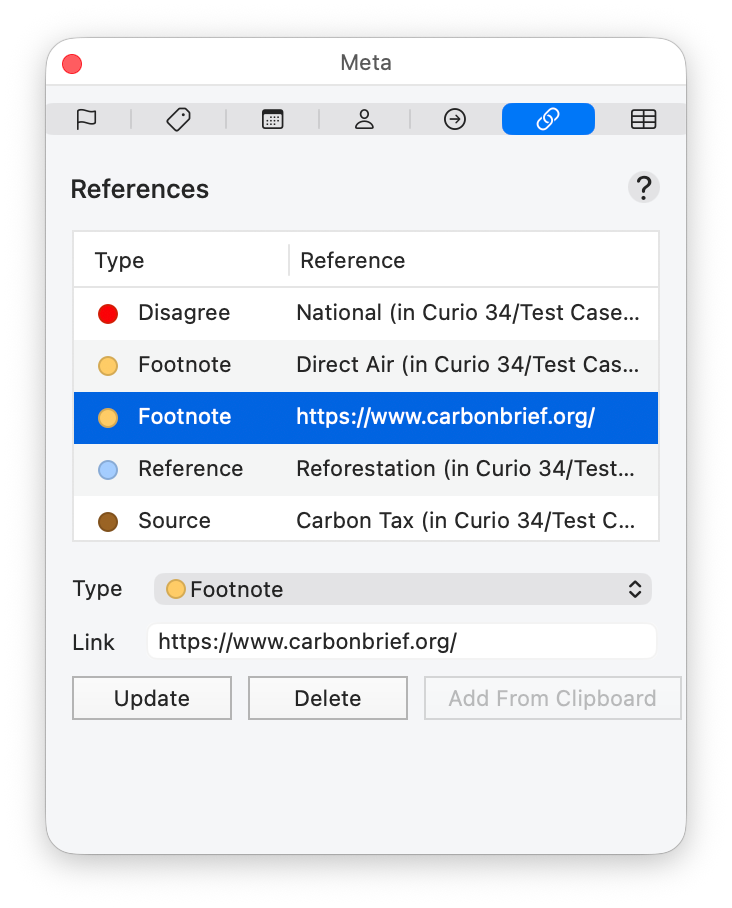
Keep supporting evidence close to your ideas. Curio Pro’s new References panel lets you link a figure to related content in Curio or on the web, with a reference type that describes the connection. Find it in the Meta inspector.
Use Add from Clipboard to create a reference from either a copied Curio jump target or a URL currently on the clipboard. Web references can be updated later, while Curio jump references remain read-only.
Select a reference and click the arrow next to its Link field to jump to its Curio target or open its URL.
With multiple figures selected, Curio shows only references shared by every selected figure (same type and same target), so you can update or delete those common references in one step.
Project Tag Sets
Give each project its own tag sets! Create statuses, categories, or other tags just for that project, complete with custom colors and ordering, without adding them to your global tag sets.
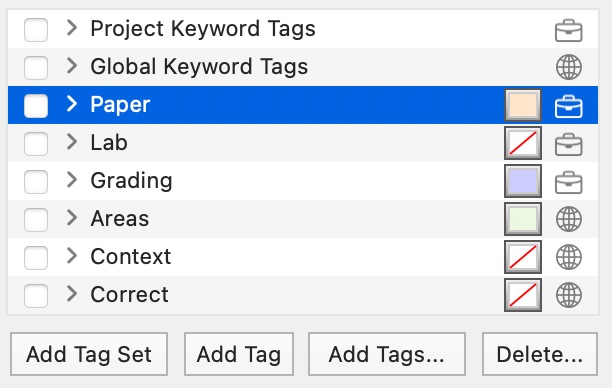
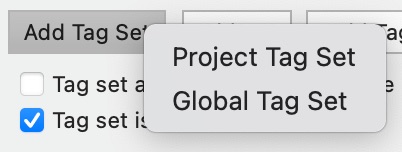
Project tag sets support all the same features as global tag sets including custom colors, adding and removing tags, renaming, and the Only One Tag Can Be Set option for use with Kanban board grouping. They also appear in Kanban grouping and Status Shelf sort and group-by menus.
Use the Actions menu to promote project keywords to a global or project tag set, or convert an entire project tag set to a global tag set. Tags and tag sets can be reordered via drag and drop within their respective zones, and separate sort commands are available for project and global tag sets.
Relatedly, throughout the docs and UI, we've renamed Local Project Tags to Project Keyword Tags, and Cross Project Tags to Global Keyword Tags just to standardize our terminology.
Curio CLI

curio, opens Curio to Terminal users, shell and Python scripts, AI agents such as ChatGPT, Codex, Claude Code, Antigravity CLI, and OpenClaw, and MCP hosts such as Claude Desktop.
- Ask for help with your ideas. Give an AI assistant access to your project to search and analyze content, rewrite text, work with images, or update tags, dates, and other metadata.
- Automate everyday work. Use the
curiocommand from Terminal or shell and Python scripts to read and update figures and idea spaces, create Organizer sections, import and export content, navigate to items, or run a batch of commands. - Explore projects without opening them. The read-only
--projectmode can query a.curiofile with Curio closed. To make changes or work with your current selection, use the running app.
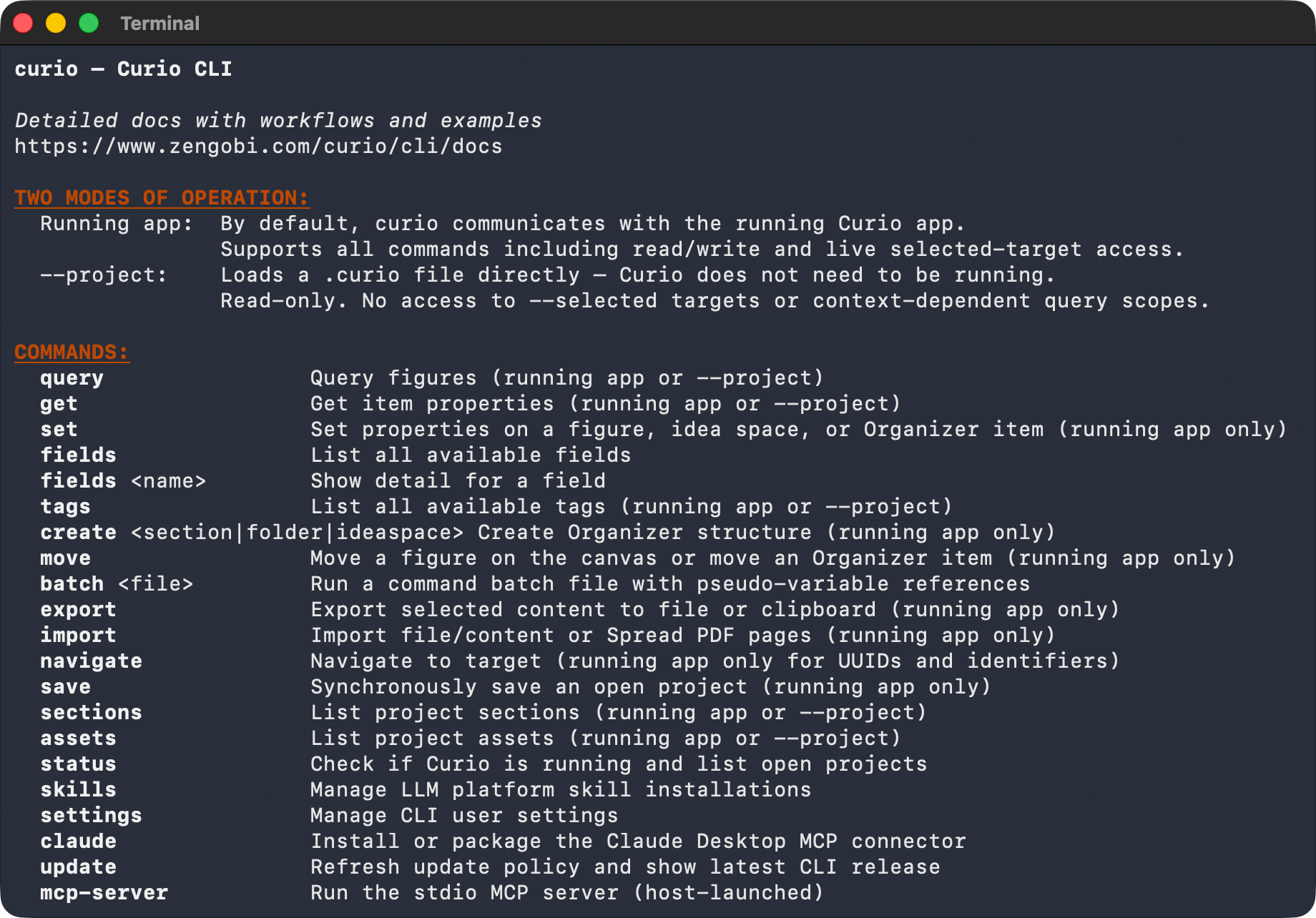
The CLI is available to Curio Pro sustainers with an active subscription or a traditional license within its current update window. It’s a separate download that runs natively on Apple silicon and Intel Macs and works with both website and Mac App Store editions.
The CLI checks for its own updates, so new automation features and fixes can arrive between Curio releases. See the Curio CLI docs and release notes for details.
Curio MCP

The MCP server is included with the Curio CLI and gives your assistant access to the same tools as the command line. For Claude Desktop, run curio claude install to create and open a Claude Connector package with Curio’s tools ready to configure. Other compatible clients can launch curio mcp-server.
Curio MCP is available to Curio Pro sustainers with an active subscription or a traditional license within its current update window.
Automate Curio with Shortcuts

- Find and open your work. Use Open Project, Find Items, and Navigate to get to the content you need.
- Work with your selection. Get Selected Figure, Get Selected Figures, and Get Current Idea Space let your shortcut use what you’re working on in Curio.
- Bring content in and send it out. Import Into Current Idea Space, Export Selected Figures, and Export Selected Idea Spaces let you pass files, links, and exported documents between Curio and other Shortcuts actions.
All of these are native Shortcuts actions, ready to use without command-line setup.
Curio macOS Widgets
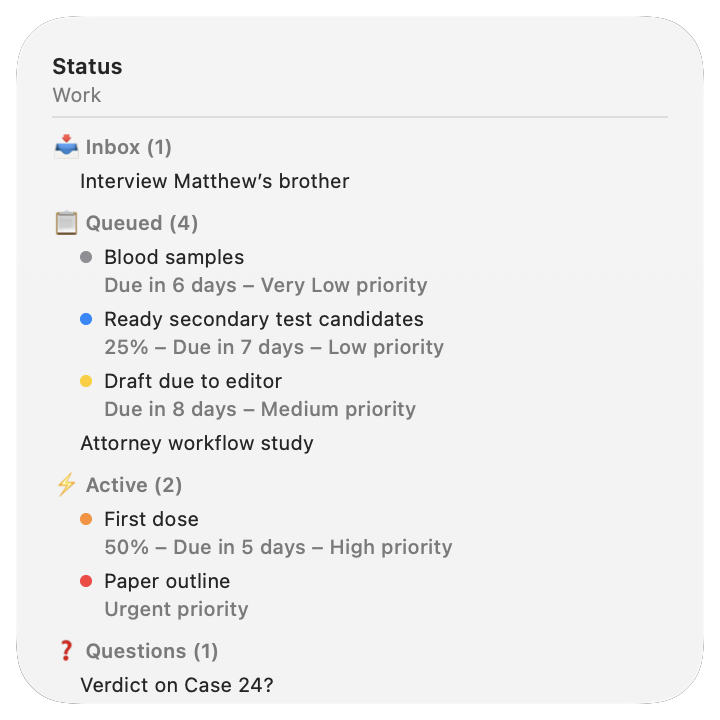
The Status widget mirrors Curio Pro's Status shelf, showing tasks aggregated across all your projects in a single zero-configuration view. It automatically reflects whatever grouping and sorting you have selected in the Status shelf. Status widgets are available in medium and large sizes.
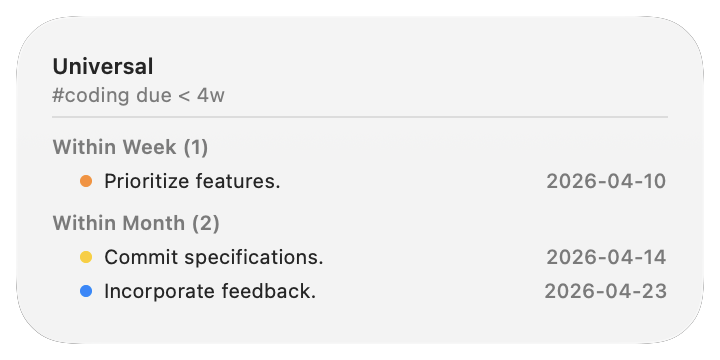
The Query widget displays results from a specific project query. Configure each widget with a project and a Curio query string and the widget shows matching items with priority indicators, due dates, progress, and other metadata. Query widgets come in small, medium, and large sizes, and support grouped and sorted results just like Search. You can add multiple Query widgets with different projects and queries to build a personalized dashboard. Tapping any item opens Curio and navigates directly to it.
Paragraph and Character Text Styles
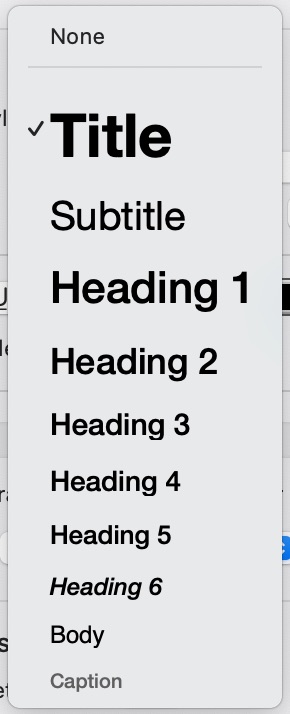
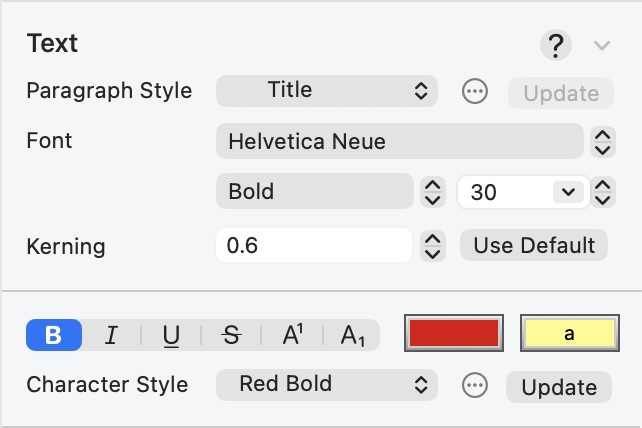
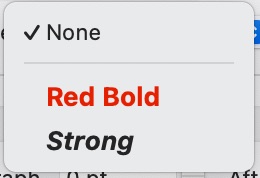
Make changes to styled text, then click the Update button to update the style and broadcast those changes to all text that uses that style throughout your project! For paragraph styles, Curio promotes the formatting at the insertion point or start of the selection to the entire current paragraph before propagating the updated style.
Curio Pro Markdown users can specify text style names in their master Markdown file to keep rich text styles and Markdown styles in sync, ex: # = paragraph-style: Heading 1. Tweak your text style and instantly your Markdown reflects that change as well!
Use the actions menu to create, rename, delete, and clear overrides; deleting a style keeps the rendered text as-is. Export/import project text styles with your personal repository. These styles are imported automatically into new projects.
New Kerning Options
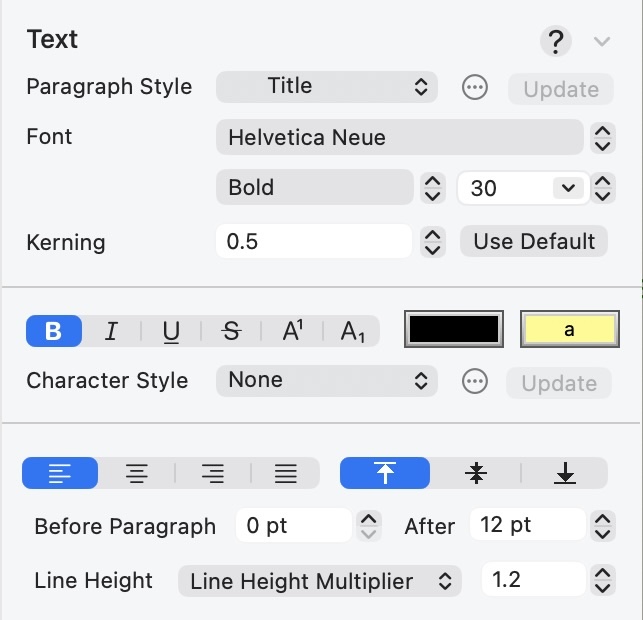
As shown in the text inspector screenshot above, a new Kerning control lets you adjust the spacing between characters for the selected figure or text. Tighten it to pull letters closer together or loosen it to spread them apart — handy for fine-tuning the look of titles and headings.
New Line Height Options
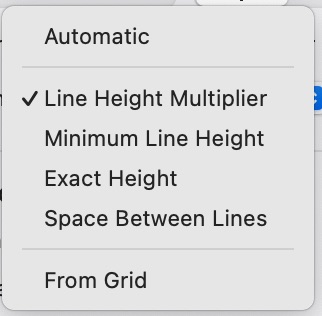
The text inspector's Line Height popup now offers Automatic, Line Height Multiplier, Minimum Line Height, Exact Height, Space Between Lines, and From Grid. This means you can easily specify spacing parameters without having to jump into the macOS Spacing dialog.

New Paragraph Spacing Controls
The text inspector now allows you to set extra spacing before and after paragraphs. Enter point values or use the steppers; use 0 to remove extra spacing. Much easier than having to use the macOS Spacing dialog.

New Adornment Positions
The Adornments position control now supports additional top and bottom placement options near the corners, giving you 12 total positions around a figure for checkboxes, tags, dates, priorities, ratings, and other adornments.
Separated Checkbox Adornments
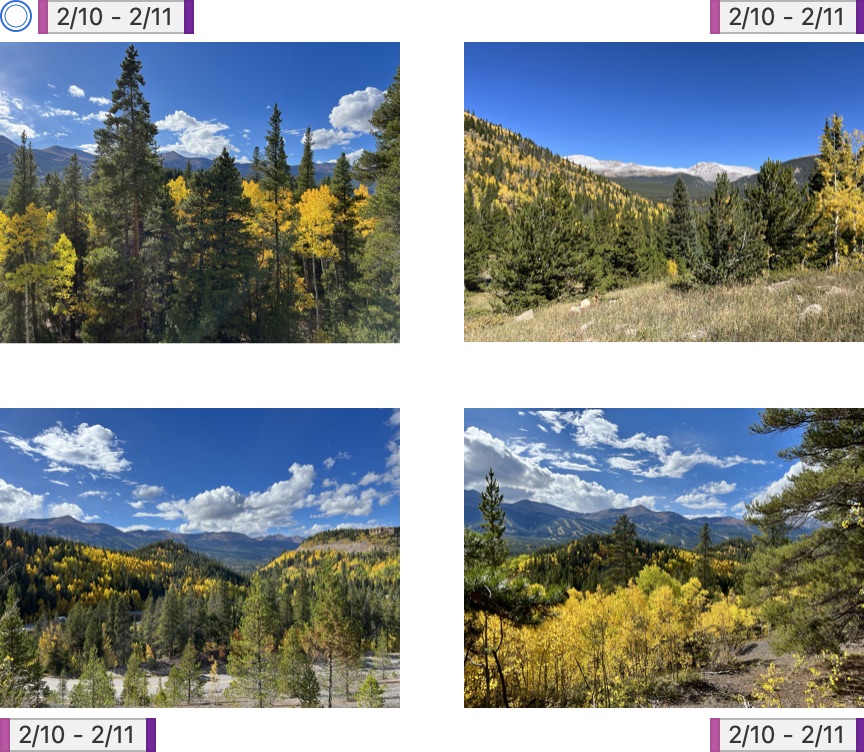
As demonstrated in the Kanban screenshots above, you can now optionally keep the checkbox adornment pinned on the left while placing all other adornments (tags, dates, priority, rating, and more) anywhere around the figure.
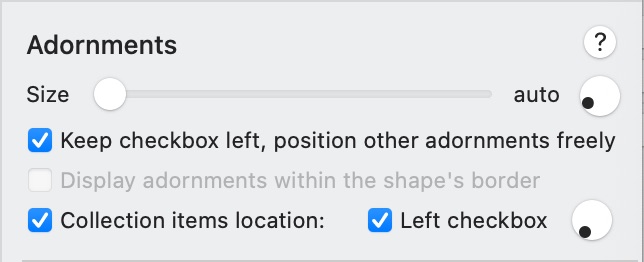
This gives you a stable checklist lane for fast scanning while still letting metadata adornments sit on the top, bottom, or right sides as needed. List and mind map layouts now honor each figure's adornment location instead of forcing adornments to the left.
Collections can now optionally force adornment placement for contained items via the Meta inspector with a Collection items location: toggle, plus Left checkbox and a radial position control for item adornments.
For Kanban boards this collection-level override is especially useful because the board pushes those settings into its managed stacks, helping keep columns compact and consistent even when stack styles change.
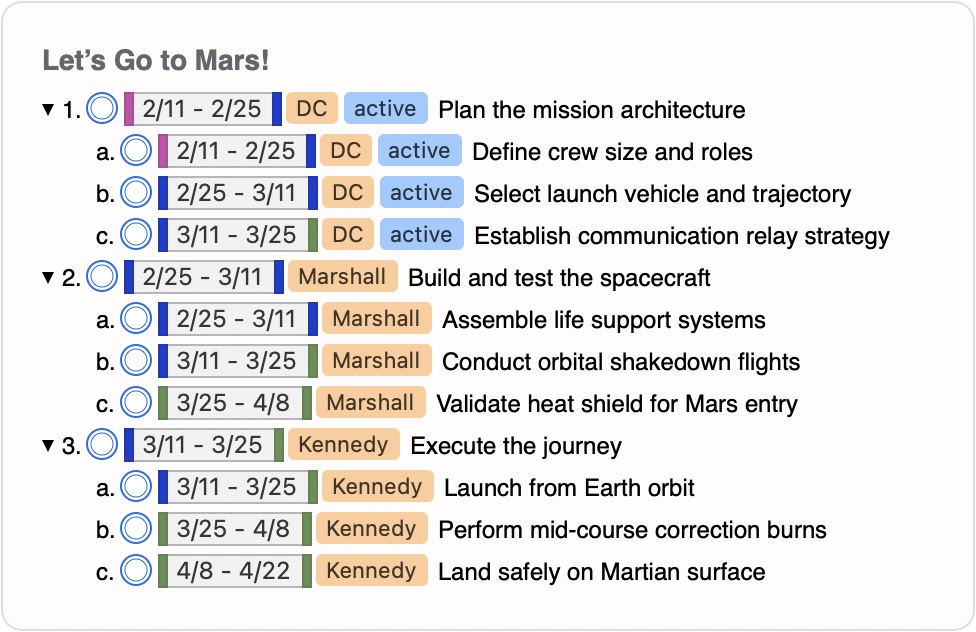
Here's a list with all adornments on the left as Curio has always done it in the past:
And here's what it looks like with the only checkbox on left and all other adornments either in the new bottom-face-left location or in the right-face-middle location:
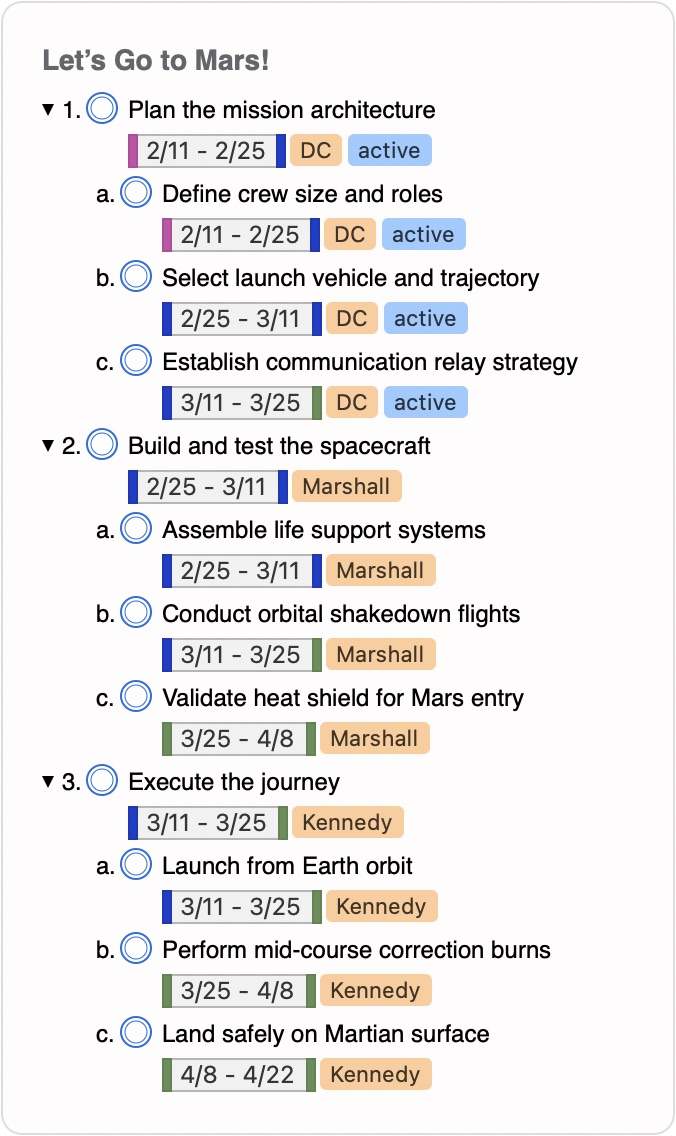
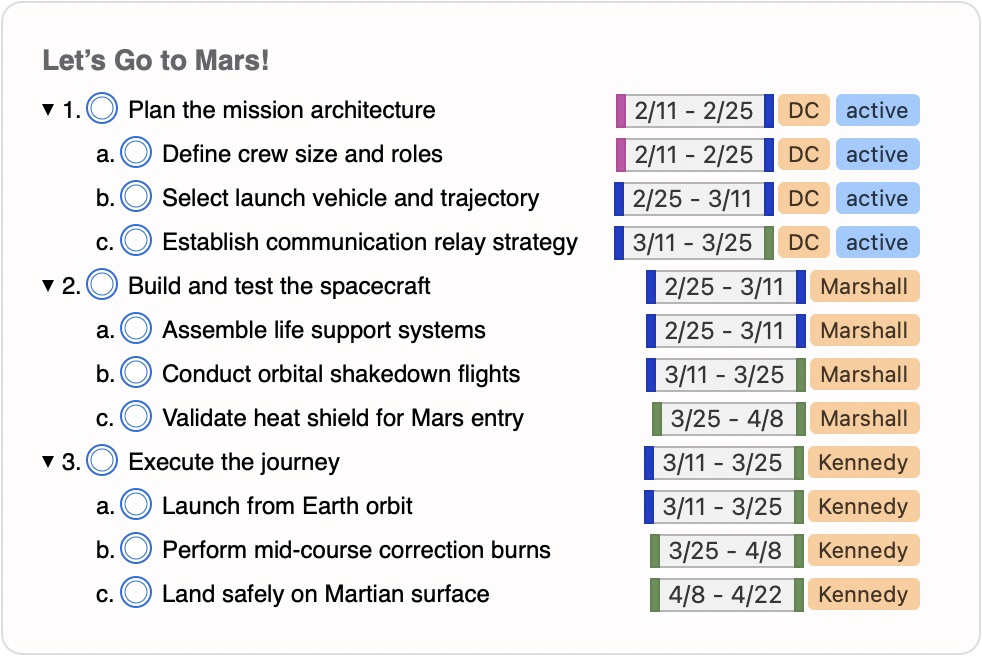
Presentation Jump To Context Menu
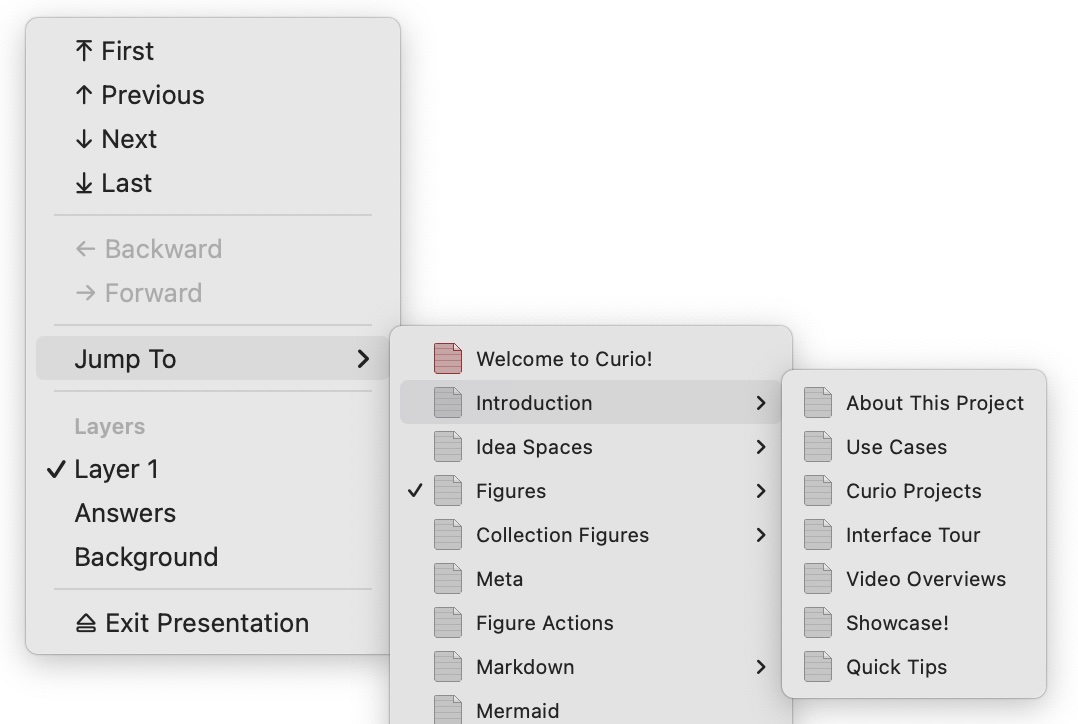
Curio Pro's presentation mode context menus now include a new Jump To submenu that mirrors the Organizer hierarchy for the current section, so you can jump directly to any available idea space without leaving presentation mode.
The currently displayed idea space is shown with a checkmark in the Jump To hierarchy, making it easy to track where you are while presenting.
Choosing an idea space from Jump To immediately switches to that idea space using Curio's normal presentation navigation behavior.
Home Button in Navigator Controls
The navigator controls now include a Home button so you can instantly jump to your designated Home idea space.

Hold Shift while clicking Home to set the currently selected Organizer item as Home.
Hold Shift+Option while clicking Home to clear the current Home setting.
If no Home has been set, Curio will jump to the first Organizer item.
Focus for Idea Graphs
Follow a connected idea without the surrounding distractions. Focus now follows arrows between figures, keeping downstream ideas visible while dimming unrelated content. Select one or more figures in your freeform idea graph and turn on Focus to see their connections.
Curio follows the direction of each arrow; arrows at both ends connect ideas in both directions. Your focused view updates automatically as you add, remove, or reconnect lines, or change their arrowheads.
Lines without arrowheads are ignored by default. Enable Focus Flow Include Undirected Lines to follow them in both directions too.
Word Count Status Bar Module
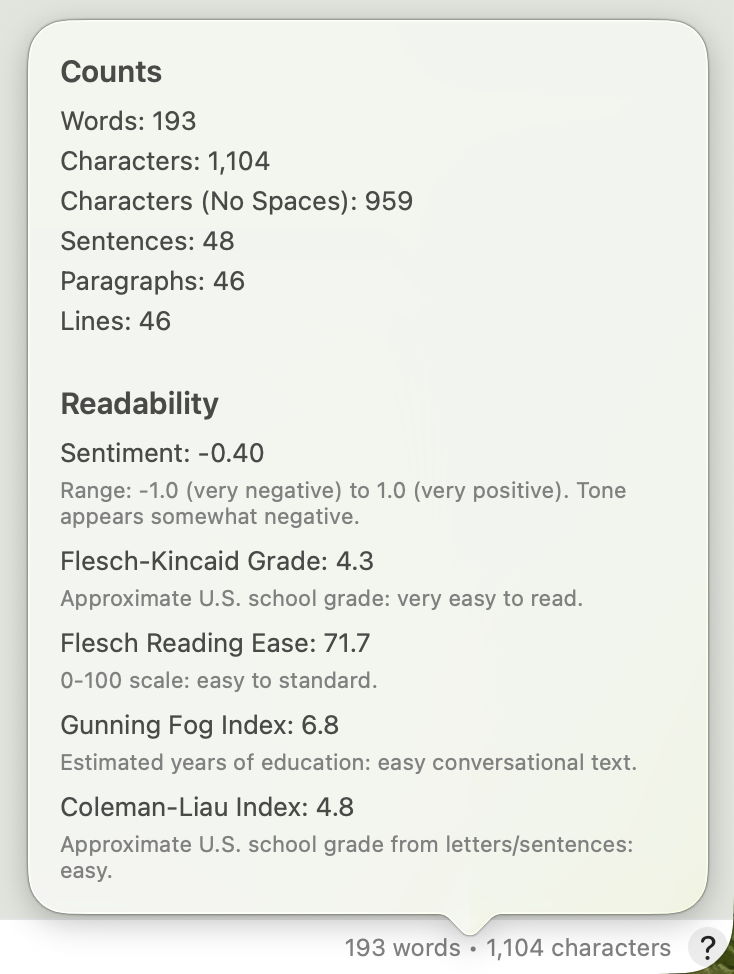
A new Word Count status bar module is now enabled by default, showing a live summary of words and characters for selected content, and you can enable or disable it anytime via View > Show Status Bar Module.
Click the Word Count summary to open a detailed popover with Words, Characters, Characters (No Spaces), Sentences, Paragraphs, and Lines, plus readability and sentiment metrics, including Flesch-Kincaid Grade, Flesch Reading Ease, Gunning Fog Index, Coleman-Liau Index, and Sentiment.
Color Sliders and Eyedropper
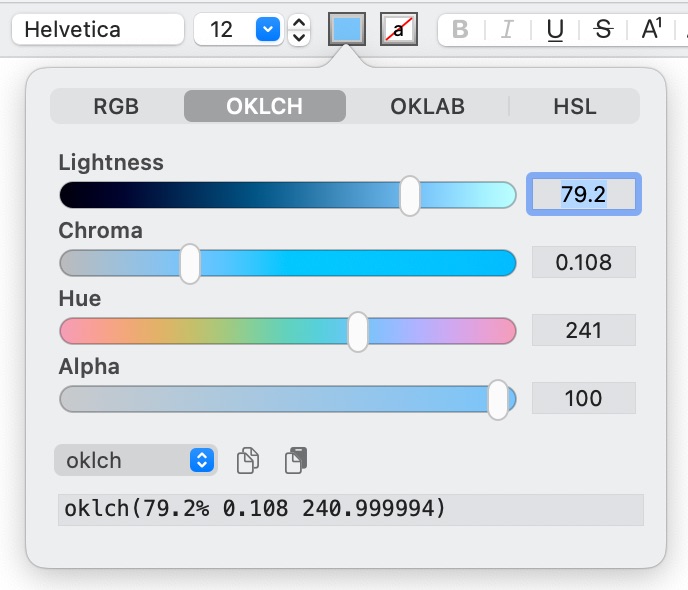
Curio's inspector color wells (text color, pen color, fill color, ...) now have new features! Hold Control (⌃) when clicking and you get a handy sliders panel to adjust your color in RGB, OKLCH, OKLAB, or HSL color space. Hold Command (⌘) when clicking and the system eyedropper appears so you can quickly sample any color from anywhere on screen. (Tip: Control key to control the color, Command key to command Curio to sample a color.)
In the new sliders panel, colors modified with OKLCH and OKLAB provide perceptually uniform color and consistent lightness across hues (see comparison). CSS supports both and new tools like ColorPalette Pro are appearing.
Generate Color Palettes for Lists and Mind Maps
Use the new Generate Palette color well in the list and mind map children inspectors to pick a base color and instantly spread a generated palette across main branches.
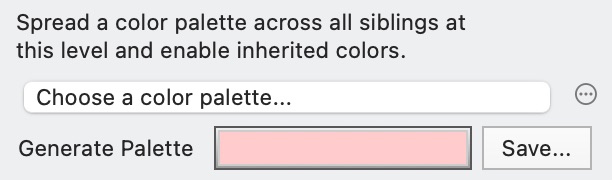
Curio generates an 8-color palette using OKLCH: it preserves the selected color's lightness and chroma and rotates hue evenly around the wheel for balanced branch coloring. It's fun to play with the new OKLCH sliders (Control-click on the palette color well) and see the mind map dynamically change with new palettes as you drag the sliders as demonstrated below.
If you like the generated result, click Save to store it as a personal color palette.
Select Figures Across Multiple Layers
Curio Pro's Layers popover now supports ⌘-clicking multiple layer rows so you can select figures across several layers at once — handy for moving, duplicating, or deleting figures that span layers.
A plain click still sets the active layer and collapses the selection back to just that one layer. ⌘-click any additional layer rows to include them; ⌘-click again to remove. Their rows stay highlighted to indicate they're participating. When more than one layer is selectable, the Layers button in the inspector bar shows a colored +N suffix (e.g. Layer 3 +2) and a footer hint in the popover reflects the current state.
Canvas marquee selection and click hit-testing will then include figures on any of the selectable layers, and operations like move, duplicate, cut, and delete work across them. Copy and paste remain layer-agnostic — pasted figures always land on the active layer. Hidden layers are never included. Locked layers can be added to the selectable set so their figures can be copied, though individual figures on those layers still can't be moved or deleted.
Local HTML Figures
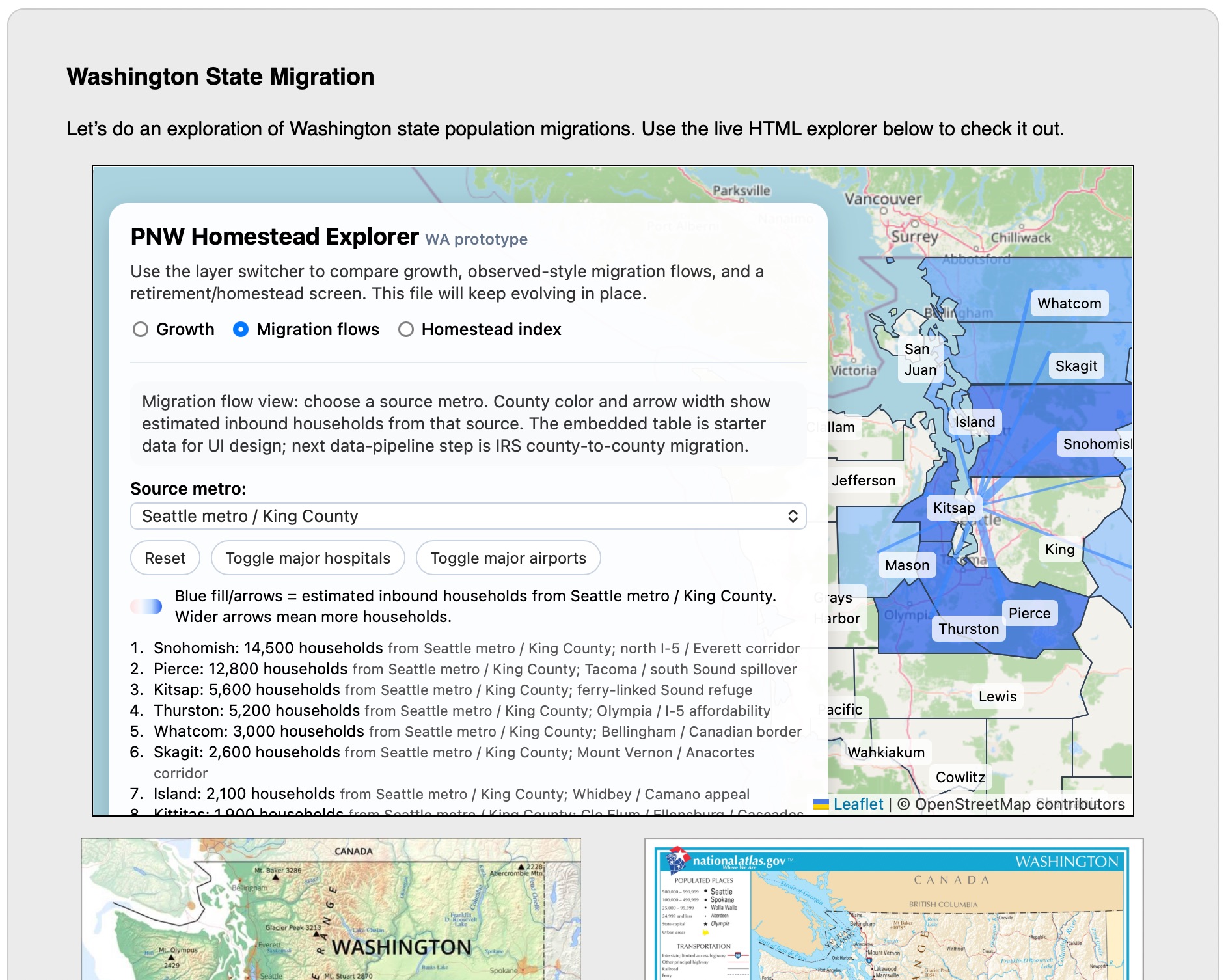
Bring interactive dashboards and visualizations right into your project! Drop a local HTML file into an idea space or collection and use it as a live web view—handy for interactive tools created with ChatGPT or Claude. The example below shows one in a tabloid composition.
Once placed, the figure immediately appears as a live web view, while still supporting the same right-click controls as normal web links so it can be shown as an icon, Quick Look preview, or link.
Note that you can also drag .html files to the Organizer which would allow the web view to fill the window.
If you prefer local HTML files to remain normal file asset figures, turn off the Create Web Links From HTML Files advanced setting.
Improvements
- Add Multiple Tags to Tag Sets
The tag inspector now includes an Add Tags button so you can add multiple tags to the selected tag set in one step. Enter one or more comma-separated names in the prompt, then click Add. By the way, given a topic, Claude does an incredible job creating a list of suitable tags, each preceded by an emoji.
- Tag Capsule Colors
Tag capsules now sport more refined color-tinted borders and text.
- Tag Enhancements
The tag inspector actions menu now includes several new display preferences for tag capsules and inline meta.
- Simple gray capsules can be used to show tags from tag sets that don't have an assigned color, like the travel tag in the example below.
- Uppercase capsule titles make your tags really stand out.
- Inline tag emoji/image display. If you use inline tags, like #Context/Office, and that tag is associated with an emoji/image, you can choose not to show the emoji/image adornment, show the tag emoji/image if one is assigned, or show the emoji/image else a tag capsule for text-only tags with no emoji/image.
- Hide inline tags and resources. Curio can now automatically hide them when rendering text figures. For example, in the screenshots below we have a text figure titled Wash dog that has an inline tag #Context/Home. When we finish editing Curio hides it from display and instead shows it as a tag capsule adornment (if that was enabled). Clicking the capsule or using the tags inspector allows you to easily change it, just like a normal tag. Editing it again shows that behind the scenes the inline tag was updated. This means you can edit your text figures and use inline meta, but when you're done they don't clutter the rendered result.
Examples of the capsule options are shown below:
→
→
→
When you change or remove tags from the tag inspector, mini inspector, context menu, status bar, or other tag-aware UI, Curio updates the underlying inline tag text when appropriate so inline and normal tag associations stay in sync.
- Custom Data Key Ordering
Custom data keys can now be rearranged by dragging them in the Custom Data inspector panel, so project fields can follow a logical order like Name, Address, City, State, and Zip instead of always appearing alphabetically.
The custom order is saved with the project and used anywhere Curio lists custom data keys, including custom data adornments, variables, search exports, and menus. Use Sort Keys in the Custom Data actions menu to restore alphabetical order.
- Smarter Search Ranking
Curio search now uses relevance ranking for text searches in Search, Quick Find, query-based collections, widgets, and automation queries. Exact and prefix matches in figure and Organizer titles rank highest, Markdown headings in text figures receive a strong boost, and ordinary body, note, OCR, URL, and meta matches follow.
- Fuzzy Search
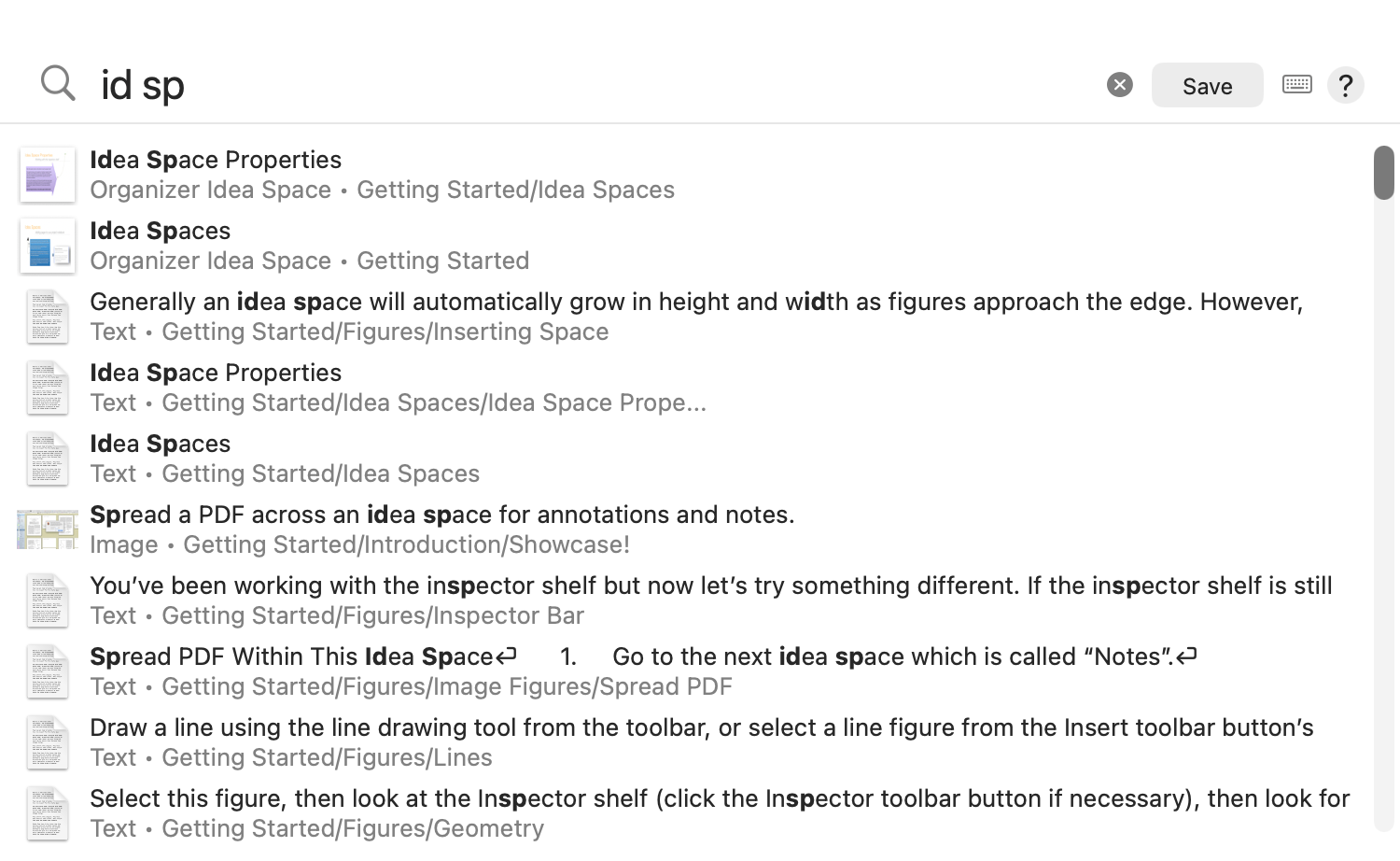
Search also includes conservative fuzzy title matching by default, so a compact query like
orgconcan findOrganizerControllerbecause those letters appear in order within one alphanumeric word. Fuzzy matching does not combine letters across spaces or punctuation such as URL separators. Usefuzzy:offfor strict contains matching,fuzzy:titlefor the default title-fuzzy behavior,fuzzy:contentfor optional conservative body-like fuzzy scoring, or~termfor an explicit title fuzzy term. You can also force relevance ordering withsort:relevanceorsort:rank, or use an explicit sort likesort:titlewhen you want alphabetical results. - Sort Search Results by Custom Data
Search queries can now sort by custom data keys using the
#prefix, such assort:#price.This keeps custom data keys distinct from native sort fields, so
sort:ratingsorts by Curio's built-in rating whilesort:#ratingsorts by a custom data key named Rating. If a#name matches both a custom data key and a tag set, the custom data key is used. - Status Bar Shortcuts
The Status Bar shortcuts have been changed:
⌘/sets focus to the Status Bar field so you can set meta attributes,⌥⌘/toggles Status Bar visibility. - Search Highlighted Text
Search and Quick Find can now find figures with highlighted text using#meta/highlighted, and highlight-only results show the matching highlighted text when possible. - Query Field Autocomplete
Query fields in the List, Mind Map, Stack, and Kanban inspectors now autocomplete tags, resources, and reference types just like Search and Quick Find. - Restrict Searches to the Note Field
You can now restrict a query's text terms to just the note field using the new
fields:notecommand. For example,peanut fields:notereturns only items with peanut in their note, ignoring matches in titles, text bodies, URLs, and OCR.The restriction applies to all text-style terms in the query — plain contains, quoted phrases, regex (
/…), and explicit fuzzy (~…) — so existing query syntax keeps working against the narrower scope. Tag, resource, date, and meta terms are unaffected. - Nudge Line Labels Off the Line
Line labels can now be nudged off the line itself. Select a label and press ⌥ (Option) plus any arrow key to offset the label by 1 point in that direction; hold ⌥⇧ for 10 point jumps. The offset is capped at ±50 points. Rotates with the line so the label tracks along as the line rotates, and is cleared when you drag the label to a new position on the line.
Plain arrow keys still slide the label along the line as before, hold ⇧ plus any arrow key for 10 point jumps.
- Gallery Filtering and Subtitle Controls
All gallery windows in Curio (including the project gallery and various template/stencil/style galleries) now include a filter field so you can quickly filter the displayed items based on title.
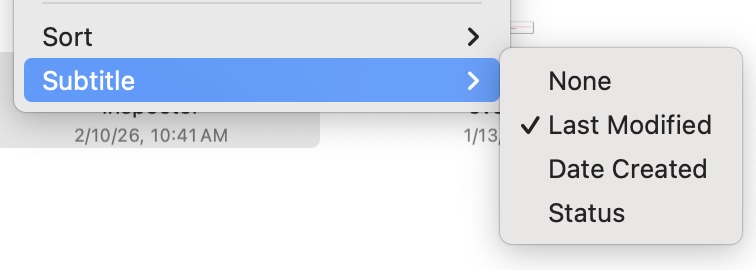
And the project context menu now includes new Sort and Subtitle submenus. Subtitle lets you choose what appears under each project title: none, last modified date, date created, or status.
- Gallery Insert Hint
The insert galleries now show a short hint below the filter field: Double-click an item to insert it, or drag it where you want it. Dragging is worth knowing about since it drops the new figure exactly where you release it, including into a specific slot within a tabloid or matrix composition. Right-click the hint and choose Hide Hint if you don't need it anymore. - Galleries and the Shelf Mini Galleries
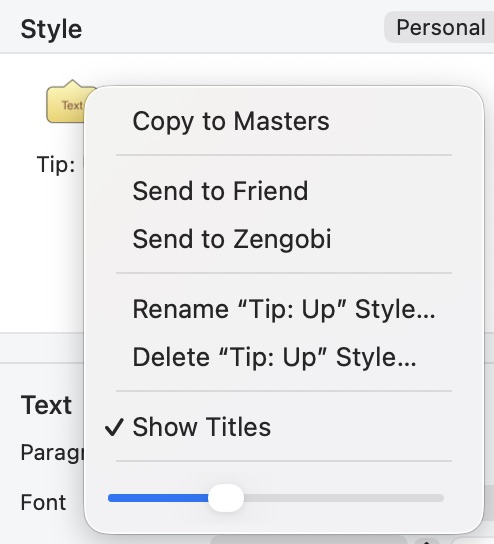
You can now right-click in the style inspector mini galleries in the shelf and toggle the display of titles (which are enabled by default) and zoom with a slider. Plus the context menu in all style galleries now includes a Rename Style menu item so you can rename your personal styles.
- Style Gallery Performance
Style galleries now open immediately and generate uncached visible previews in the background, avoiding delays at launch and when browsing large personal style collections. - Archive Personal Templates and Stencils
The templates and stencils galleries now ignore any items that are in the Archive section in those respective project files, which allows you to tidy up your personal idea space templates and figure stencils. When viewing your templates/stencils gallery, right-click on an item to edit it and it will open the item in its repository project. You can then drag it to the project's Archive section to hide it away. - Figure Helpers
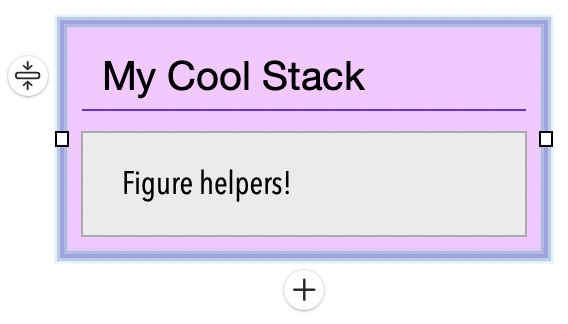
When a single figure is selected, Curio can now show contextual floating helper controls such as a stack add button and collapse/expand button, mind map add sibling/child buttons, and synced collection jump icons. You can enable or disable helper modules via View > Allow Figure Helpers.
- Text Figure Overlay Icons and Adornments
Text figures that are either file-backed or have a sync file can now optionally display a small overlay icon in the corner so you can tell at a glance what kind of external file is associated with the figure.
Rich text files show a rich text page icon, plain text files show a text page icon, and sync files show an arrow icon indicating the sync direction: export, import, or bidirectional.
An example file-backed text figure with overlay:
You can also choose to enable the icon as an adornment alongside the file-backed or sync file figure. Here are some examples with sync files. Note this works for any type of figure, not just text figures.
These are all disabled by default but can be enabled for file-backed figures and sync file figures.
- Sync File Context Menu Open Options
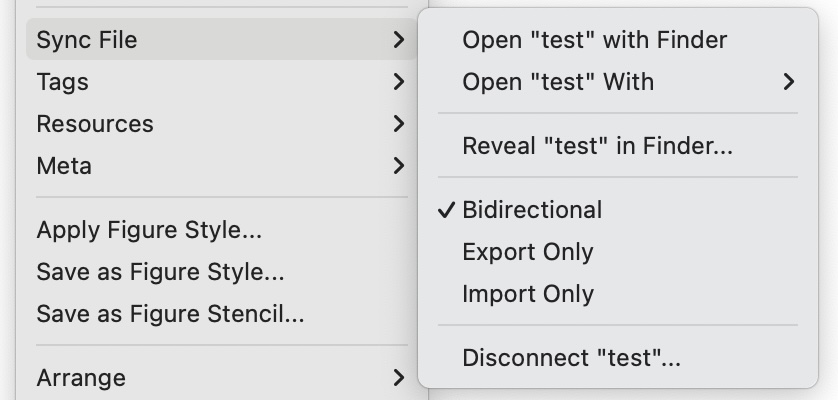
The figure context menu's Sync File submenu now includes direct Open and Open With commands.
- Convert Text Figures To File-Backed Figures
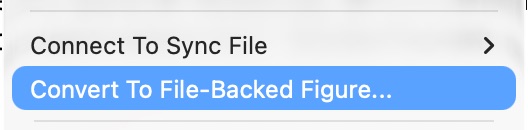
File-backed text figures used to require starting with a file, but now any text figure you've already written can be handed off to a file of its own: right-click, choose Convert To File-Backed Figure, and pick where the file should live and whether it holds Markdown, rich text, or plain text. Curio writes the figure's current text into that file and aliases it, so it stays yours to edit in another app or sync via iCloud or Dropbox, and choosing Disconnect later brings the contents back into the figure. Since a figure's text has at most one source of truth outside the project, a figure with a sync file can't be converted and a file-backed text figure's sync file is now always export only — handy for editing a figure backed by a rich text file while exporting a Markdown copy for backup.
- Text Controls, Easier to Find
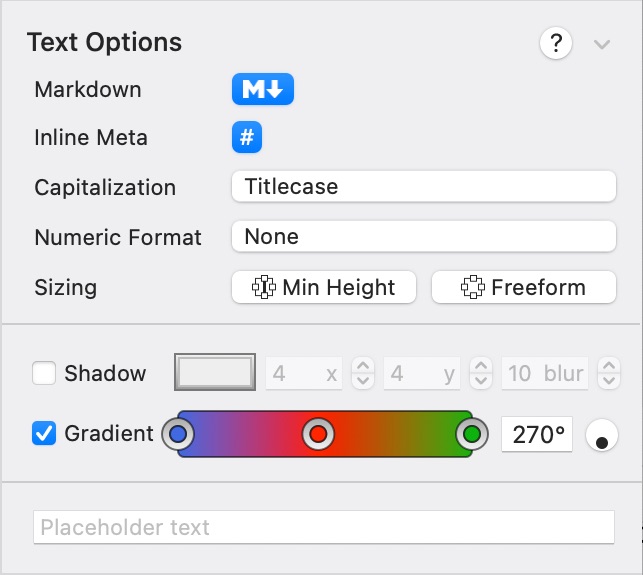
Find the text controls you need more easily. The refreshed text inspector groups related settings together, including the new typography controls. The detachable text popover in the inspector bar now has separate Text and Options tabs.
- More Formatting at Your Fingertips
Keep more room for your work. When an idea space has just one layer, the Layers control now uses a compact icon. Add more layers and it expands automatically to show the active layer name.
→
Change pen and fill colors directly from the inspector bar with the new color wells. You can turn these off if you prefer.
New alignment menus also make it easier to choose horizontal and vertical alignment without opening the shelf.
→
- Expanded Figure Mini Meta Popover
The figure mini meta popover (select a figure and press
M) has been expanded to include percent complete, priority, and rating. With this mini inspector and the dates mini inspector (pressD) there are now only 2 mini inspectors for quick meta changes. - Default Start and Due Date Times
The date inspector action menus now provide matching default-time preferences for start and due dates. Start dates can begin at midnight, the current time, or the project workday start. Initial due dates can retain Curio's normal behavior or use the project workday end.
- Numeric Inspector Keyboard Stepping
Many numeric inspector fields now support keyboard stepping with Up/Down arrow keys (±1), and Shift+Up/Down for larger ±10 increments. - Table Context Menu Conversions
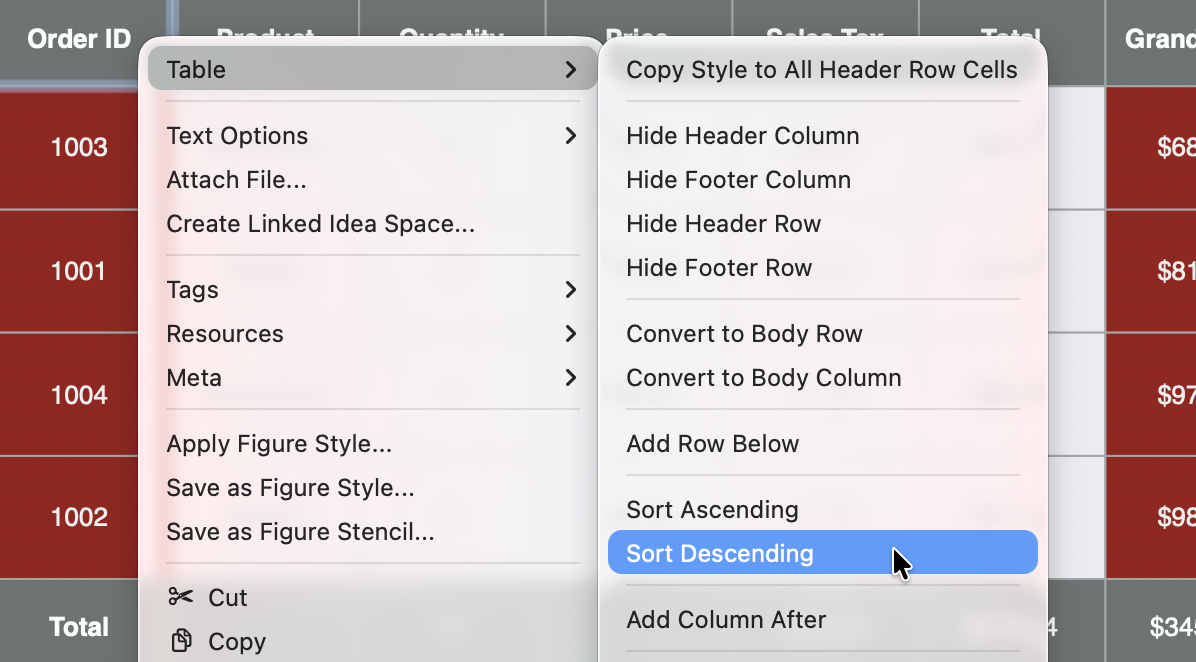
Table cell context menus now include quick conversion actions so you can convert a selected row or column to Header, Body, or Footer.
- Tabloid and Matrix Titles
The tabloid and matrix composition collections now support a title which you can toggle on in their inspectors. - Tabloid Composition Column Resizing
Tabloid compositions now support dragging the divider between adjacent columns in a row to quickly resize both columns in one motion, instead of having to type in a specific width. - Tabloid Composition Column Separators
Alongside the existing row separator, each tabloid composition row can now draw a vertical separator between its columns, with the same choice of line styles plus its own color. Turn on Tall and the separator extends into the gaps above and below to meet the row separators or the column separators of the neighboring rows, giving a multi-column composition a clean table-like look.
- List and Mind Map Level Styles
Curio once again detects when sibling figures on a list or mind map level share the same style and automatically uses that as the level default, while mixed checkmark visibility now keeps the level default unchecked so task checkmarks don't unexpectedly propagate. - List Prefix and Checkbox Spacing
Improved list row spacing so disclosure triangles, bullet or numbered prefixes, and left checkbox adornments line up more consistently across parent and child items. - List Title Gap Preference
Lists now include a configurable global preference for the gap between a visible list title and the first item, with a default spacing of 5 pixels. - Mindmap Gaps and Offsets
Updated the Mindmap Gaps and Offsets section of the advanced settings with a few additional mind map gap overrides. - Idea Space Dots Grid
The idea space dots grid has been updated with more circular dots and it's now possible to hide the dots while the grid snapping is still active. - Change Meta Across Multiple Organizer Items
You can now use the Meta inspector to change label and tag information across multiple selected Organizer items. Note that undo across all items isn't supported since each has its own independent undo stack. - Faster Bulk Organizer Creation
Improved performance when adding many Organizer items, including large Spread PDF imports created through Curio automation. - Paste Organizer Items as Aliases
After copying Organizer items within a project, you can now right-click a destination in the Organizer and choose Paste As Alias. This may be easier than using the drag-and-drop method for creating aliases. - Organizer Label Color Menus
Organizer and section label colors now use palette menus for easier access. The label name is temporarily displayed directly beneath the palette as you hover over the colors.
- Section Sorting
The Sections outline context menu now includes Sort Siblings By commands so sibling sections can be sorted by title, date modified, date created, or date added. - Rename Master Templates with Return
You can now press Return with a selected item in the Masters sidebar to rename the selected master idea space template or stencil. - Per-Project Backup Folder
Curio Professional already lets you override automatic backup settings for an individual project. You can now also override the backup folder for a project via the Advanced tab of its project properties inspector.
Click the Choose button alongside the backup folder to pick a dedicated destination for that project's backups, such as a synced Dropbox folder or an external drive. When no folder is chosen the project continues to use the global Backups folder specified in Settings.
- 📣 Markdown Headings Now Trimming Blank Lines
Markdown heading rendering now trims extra blank lines before and after headings to better match most Markdown renderers, then automatically uses dynamically computed heading paragraph spacing to preserve visual rhythm. You can turn this off if you'd like to keep the blank lines. Note that Obsidian generally keeps before/after blank lines. - Markdown Inline Math Autodetection
If Markdown autodetection is enabled then it will now detect the\(..\)MathJax inline equation syntax and automatically enable Markdown rendering for the text figure. - Expanded and Customizable Markdown Emoji
Markdown emoji cheat codes are now based on the standard gemoji set used by GitHub and others, growing from 845 codes to 1,916, plus another 843 alternative spellings that other Markdown editors accept — so:blue_circle:works alongside:large_blue_circle:, which helps with figures you also edit elsewhere. All of your existing codes still work, codes are now matched case insensitively, and you can define your own by creating anEmoji.txtfile in your personal repository folder with onecode=emojientry per line. - Turn AI Outlines into Lists and Mind Maps
Copy a nested Markdown outline from your favorite AI assistant and paste it as a Curio list or mind map. Curio now recognizes space-indented lists as well as tab-indented ones, preserving their hierarchy. Choose Paste Markdown As > List or Mind Map to turn the outline into a collection. - Smarter Base Font for Mixed Markdown Figures
When a text figure mixes fonts — for example a stylized title above a Markdown list in a regular body font — Markdown blocks now base their styling on the font at that block's own location rather than always on the font at the very start of the figure. If you've defined a 'body' Markdown style, it's also now applied per paragraph, so a bold title stays bold (just resized) while body text keeps its own font. You can turn this off to restore the previous behavior. - Markdown Image Retina @2x Rendering
Rendered Markdown images whose filename ends with@2xnow display at 50% size by default (for exampleImage@2x.png), with a preference to toggle this behavior. - Markdown Image Size Attributes
Rendered Markdown image links now support the DEVONthink-style image size specifier:
In addition to our existing support for:
• Obsidian-style:,,
• Marked-style:,, - Markdown Image Export Size Attribute
When exporting images as Markdown Curio now supports a new setting for the DEVONthink-style image size format,, in addition to our existing settings. - Keep Your Table Layout When Syncing
Get your column widths just right once. Curio Pro now preserves your adjusted widths when a linked Markdown file changes—even when rows or columns are added, removed, or reordered. - Equations and Diagrams, Even Offline
Your equations can now render without an internet connection! Curio Pro also includes everything needed to render Mermaid diagrams and syntax-colored code offline. The required resources are now bundled with Curio, ready to use wherever you work.
You can still customize or extend any of these by creating your own
HTML Localfolder in your personal repository. Curio overlays your personal files on top of the bundled set, file by file, so your customizations take precedence while you automatically inherit everything else — including new resources added by future Curio updates. - Idea Space Split View
The idea space split bar has been tweaked with a new default focus bar width and several advanced settings to override the overall divider width, show focus state, focus bar width, focus bar color, and more. - Show Custom Data Figure Adornment
You can now globally disable showing the custom data adornment via the Custom Data panel's actions button menu. - Adornment Click Drag Handling
Clicking and dragging non-checkbox figure adornments (tags, dates, priority, etc.) will now drag the figure itself. If you click and release on the adornment, it still handles the click as usual. The checkbox adornment still handles the click on the initial mouse down or touchpad tap. - Hide Note Adornments
You can now hide note adornments, for those figures that have notes, via the new Flags Show Notes advanced setting. - Modernized Figure Tooltips
Figure tooltips were completely rewritten to be more robust and less intrusive, with cleaner modern styling, improved sizing for enclosed text, and predictable width-based wrapping for longer content. - Immediate Hover Status Bar Updates
Hover text now appears immediately in the status bar while figure tooltips continue to honor their configured display delay. - Link Action Title
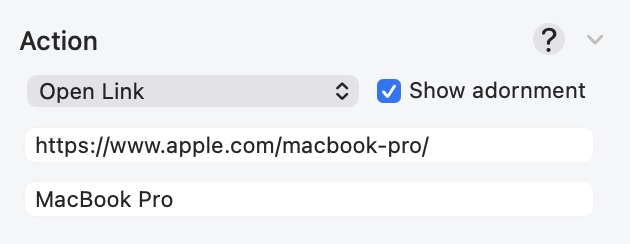
The Open Link figure action now supports an optional title. When set, figure tooltips and the status bar show the title instead of the potentially messy URL — great for long or tracked links.
- Insert Popover Window Level
Insert popovers now use the same window level as other inspector popovers, so they appear above detached inspector windows while remaining below modal alerts. - Smarter URL Detection
Curio now uses Apple's data detector for link detection (instead of the less reliable NSURL default) when pasting, importing, or parsing text. - Refreshed Note Card Text Styles
All bundled figure styles, including the colored note card text styles, have been modified so those that used Chalkboard now use Helvetica. Chalkboard is getting a bit dated and doesn't support italics. If you previously used one of the old Chalkboard styles, just select one of your existing figures and save it as a personal style. - Refreshed Appearance Themes
Curio's bundled appearance themes have been refreshed with more refined color palettes and more distinct light and dark theme choices. - Status Shelf Open Project in New Window
The Status Shelf projects list context menu now includes an Open Project in New Window command at the top, making it easy to open any right-clicked project in a separate window without changing your current selection. Double-clicking or Option-clicking a project in the list will also do this. - Independent Status Shelf Task Views
Each open Status Shelf now keeps its own task scope, grouping, and sorting selections during the current session, so refreshing one project window or tab won't unexpectedly rearrange the task list in another. - Modern HTML Export
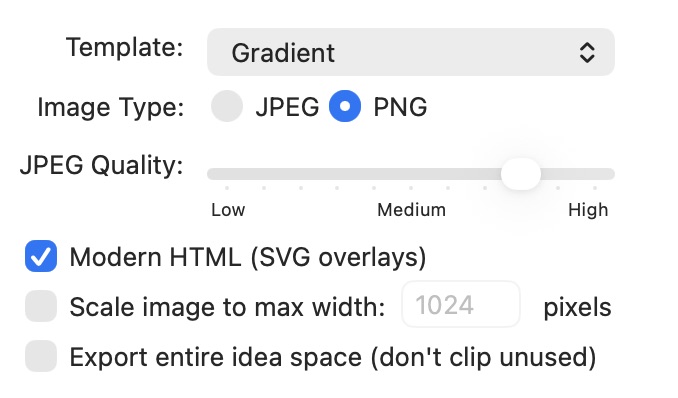
HTML export now includes a Modern HTML (SVG overlays) checkbox. When enabled, Curio replaces the classic HTML image map with an SVG overlay, where clickable figures are highlighted with a subtle hover effect making them easily discoverable. Asset figures also display native browser tooltips with the figure title. The classic image map mode remains the default for maximum compatibility.
- HTML Export Figure Metadata
HTML exports now include a per-slideallFiguresarray with figure geometry and metadata so custom templates can add richer interactions such as click-to-inspect metadata panels. - Trial Notification Moved to Status Bar
Trial and license notifications have moved from the window title bar to a dedicated status bar module, freeing up space in macOS Tahoe's more compact title bar area. The notification appears as a clickable button alongside the word count and meta modules. - Manage Authorized Folders
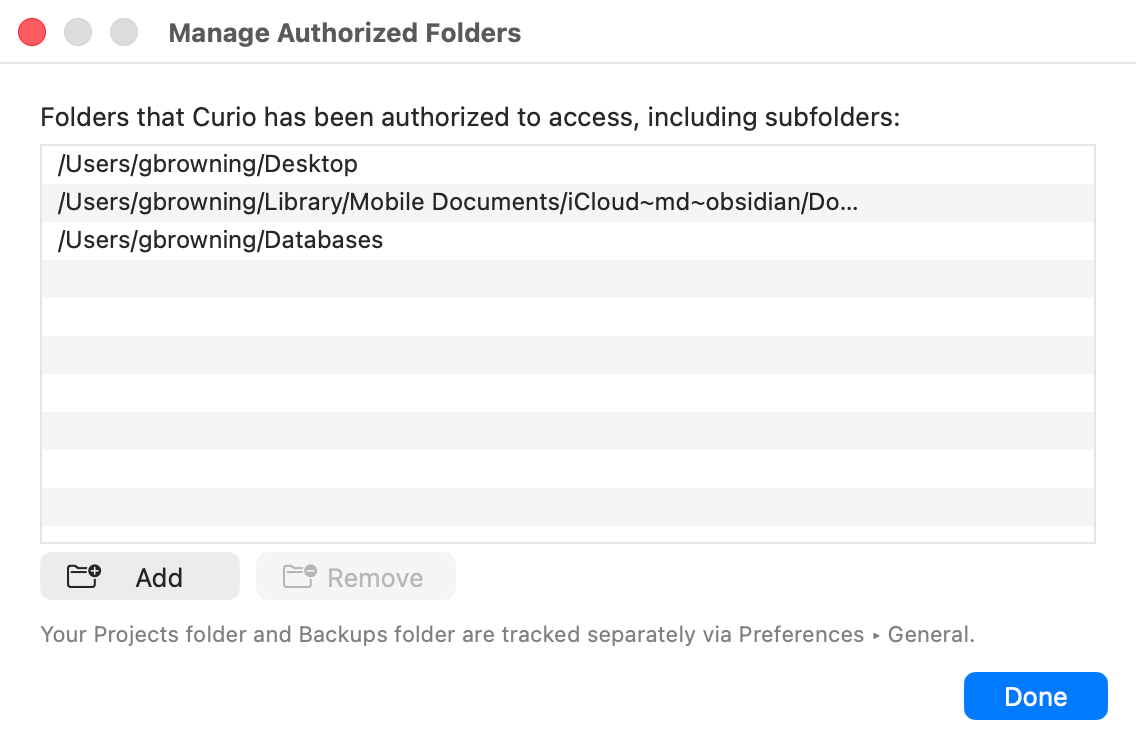
The Mac App Store edition of Curio now includes a File > Manage Authorized Folders menu item so you can view and manage the folders Curio has been authorized to access. You can add new folders or remove existing ones. Your Projects folder and Backups folder are tracked separately via Curio > Settings.
- Mac App Store Trials
Mac App Store users can now download Curio and begin a free 14-day trial without purchasing a subscription first. - Mac App Store Subscription Dialog
The Mac App Store subscription dialog now uses a richer web-based pricing page with localized RevenueCat pricing, active-plan highlighting, integrated subscription fine print, and links for terms, privacy, and subscription management.
- Newer-Version Project Warning
Curio now warns you when you open a project that was last edited with a newer major version of Curio, since saving could remove data that this older version doesn't understand. - Idea Space Rulers
Idea space rulers now support Curio theme colors and look better in light mode when no theme coloring is active. - [34.0.3] Automation Scheduling
The shared automation API now exposes start and due date calculation techniques, duration and duration units, plus the effective techniques used for automatic scheduling. CLI and MCP clients can explicitly select manual dates, collection-based scheduling, or a due date calculated from Start plus Duration.


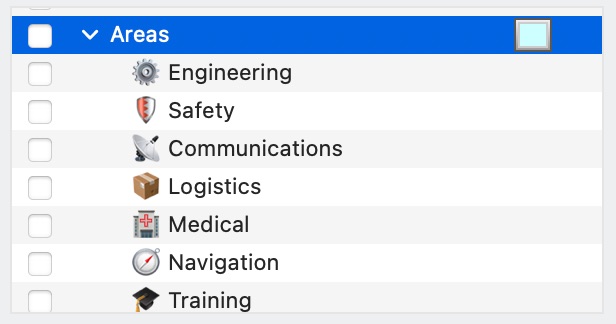

 The tag inspector actions menu now includes several new display preferences for tag capsules and inline meta.
 →
→  →
→  →
→ 
 Line labels can now be nudged off the line itself. Select a label and press ⌥ (Option) plus any arrow key to offset the label by 1 point in that direction; hold ⌥⇧ for 10 point jumps. The offset is capped at ±50 points. Rotates with the line so the label tracks along as the line rotates, and is cleared when you drag the label to a new position on the line.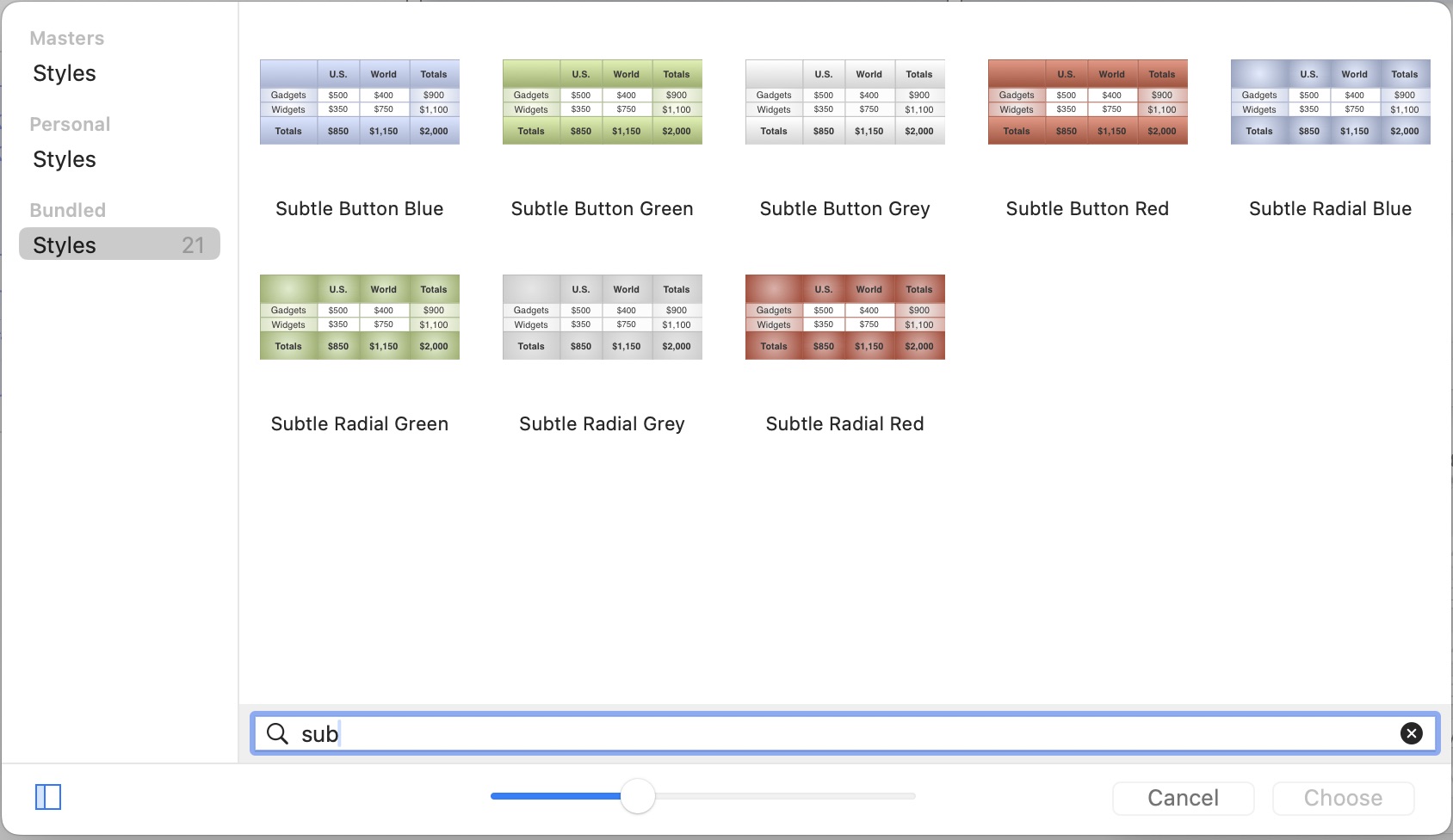



 →
→ 
 →
→ 
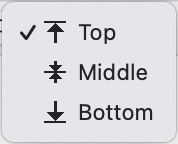
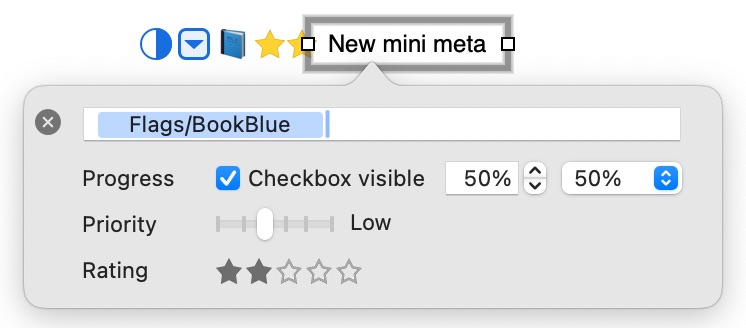
 Table cell context menus now include quick conversion actions so you can convert a selected row or column to Header, Body, or Footer.
 Alongside the existing row separator, each tabloid composition row can now draw a vertical separator between its columns, with the same choice of line styles plus its own color. Turn on Tall and the separator extends into the gaps above and below to meet the row separators or the column separators of the neighboring rows, giving a multi-column composition a clean table-like look.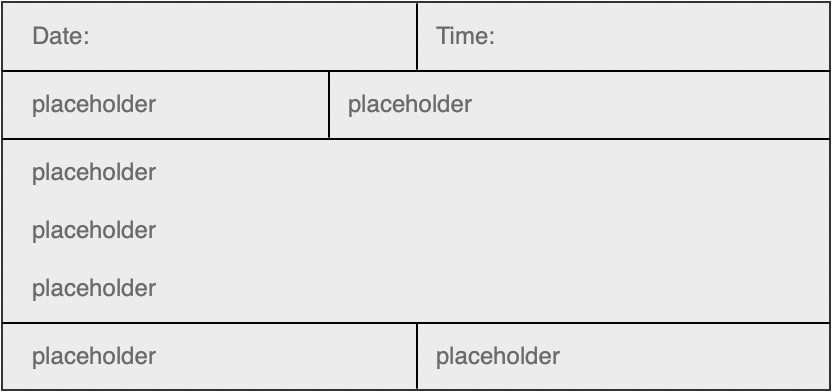
Fixes
- Regenerating Idea Space Previews
Reduced memory usage when regenerating previews or thumbnails for many idea spaces. - SVG Rendering Hang
Fixed an issue where rendering certain SVG assets, including some Mermaid-generated SVGs, could hang Curio and exhaust memory, potentially while regenerating idea space previews after opening a project. - Idea Space Figure Preview Updates
Fixed an issue where idea space link figures wouldn't update their displayed preview when the referenced idea space's content changed, such as when dragging items around. - Markdown Export with Assets
Fixed an issue where exporting figures as Markdown with their assets could fail or produce incorrect asset output. - Rotated Figure Clipping
Fixed an issue where a rotated image figure may appear clipped. - Image Style Gallery Previews
Fixed an issue where selecting a URL figure shown as a live preview could cause image figure style previews to render as text samples until Curio was relaunched. - List Prefix Font Sizes
Fixed an issue where list prefixes could render at the wrong size when individual list item fonts were changed. - Bulleted List Disclosure Triangles
Fixed the layout of bulleted lists containing child items. Because a bulleted parent shows its disclosure triangle in place of its bullet, the list is no longer indented to make room for the triangle, and the triangle now sits exactly where the bullet would have been, so parent rows line up with their siblings instead of drifting left and crowding the triangle. - Collection Underline and Text Color
Fixed issues where setting underline or text color on an entire collection wasn't remembered for newly added items: underline was mistakenly recorded as strikethrough in the collection's level styles, and text color wasn't recorded at all. - Matrix Row Insertion
Fixed an issue where adding a partially filled row to a matrix could unexpectedly make the entire matrix wider. - Tabloid Composition Figure Spacing
Fixed an issue in tabloid compositions where text figures without a border or fill left a larger gap below the text than above it, both within a row and beneath the composition's title. Figures with a border had the same imbalance, since the border is stroked outside the figure's box and so crept up into the gap above while leaving that same slack below. - Deeply Nested Lists
Fixed a potential crash when a list hierarchy was nested more than 31 levels deep. - Sorting Collection Items by Title
Fixed a potential crash when sorting collection items by title if some items had no text. - MindManager and iThoughts Exports
Fixed MindManager (MMAP) exports so task durations reflect each exported topic instead of the collection itself, fixed iThoughts (ITMZ) exports of hyperlinks containing special characters, and both exports now report an error instead of producing an invalid file if writing fails. - Toggling Rendered Markdown Checkbox to Sync File
Fixed an issue where clicking a checkbox in a rendered Markdown list backed by a sync file showed the checkbox toggle, but didn't sync that change to the external sync file. - Bidirectional Sync External Changes
Fixed a race where a pending local sync export could overwrite a newer external edit before Curio's delayed import began. External change notifications now suppress pending exports immediately, plain-text exports are atomic, and Curio records the exact file snapshot it imported. - Markdown Meta Import
Fixed Markdown checklist imports so an explicit code>@done(date)</code is not replaced by the current time, malformed or unresolved function-style metadata such as code>@tags(...)</code can no longer be mistaken for an inline resource, and multiple inline metadata tokens convert safely. Bare tag names now prefer project keyword tags and fall back to global keyword tags, while a leading slash explicitly selects a global keyword tag. Named tag sets must be specified explicitly, avoiding ambiguous matches when several sets contain the same tag name. - Escaped Markdown Headers
Fixed an issue where escaping a Markdown header with a backslash (such as# = ..., useful when documenting Curio's master Markdown styles file format) was incorrectly stripped before the Markdown renderer could handle it, causing the line to be rendered as a heading anyway. The inline tag/resource escape (#Tag, code>\@Name</code) now only unescapes when the next character is actually part of a tag or resource name. - Single-Line Markdown Lists
Curio no longer treats a single-line text figure that starts with a bullet or number prefix as a Markdown list, avoiding accidental list rendering in table cells and mind map nodes, while single-line Markdown task lists such as- [ ] Taskstill render as checkboxes. You can turn this back on if you'd like Curio to render generic single-line Markdown lists. - Table Header Resize
Fixed an issue where resizing a table or changing a table's style could instantly make the header row its minimum height if the table was set to autoresize rows to fit cell contents. - Text Inspector Popup Selection
Fixed an issue where the Text Formatter and Text Capitalization popups in the figure text inspector could fail to refresh when switching between selected figures. - Text Highlight Color Shortcut
Fixed an issue where holding Shift over the text background color well could fail to preview and apply the last-used highlight color. - Custom Data Value Double-Click Editing
Fixed an issue in the figure metadata custom data table where double-clicking a value could open key editing instead of immediately editing the selected value. - Alias Badge Icon
Fixed an issue on macOS 26 where the alias badge icon overlaid on alias figures appeared oversized. - SearchKit Indexing Hang
Fixed an issue where SearchKit indexing of PDFs and Office documents could block the main thread for extended periods, causing the app to hang. Indexing now runs on a background serial queue. - Search Shelf Deep Text Matches
Fixed an issue where Search shelf results could show only the beginning of a figure's text instead of the matching text when the match was deeper in the figure. - Search Autocomplete
Fixed issues where Search and Quick Find tag autocompletion could reapply a completion while deleting text, wouldn't complete tag names after a tag set slash, or couldn't match through tag emoji. - Smart Kanban Organizer Results
Fixed an issue where query-backed Kanban boards could repeatedly add duplicate Organizer item results when a section-scoped query matched folders or idea spaces. - Organizer and Sections Drag-and-Drop
Fixed misleading insertion indicators that could appear beneath the last Organizer item or section when dragging too far left. Invalid positions are now rejected, while dropping into genuine blank space in the Organizer still appends at the end. - Sleuth Shelf ChatGPT Sign In
Fixed an issue where signing into ChatGPT for the first time within the Sleuth shelf could fail before the email verification code step. - Tag Matching with Emoji
Fixed tag matching in search queries and automation so tag names now ignore emoji in addition to case and spaces, making emoji-decorated tags easier to find and set. - Reordering Master Templates
Fixed an issue where dragging a master idea space template to a new location in the Masters sidebar could unexpectedly switch the sidebar back to the Organizer. - Master Stencil and Template Propagation
Fixed several issues with master propagation: stencil changes now detect the correct instance layer instead of always defaulting to the top layer; switching templates now preserves edited text inside grouped figures; new figures added to a master group are now correctly placed inside the group on instances; figures moved between layers on the master are now relocated on instances; duplicate figure identifiers no longer silently misroute content during template switches; and instance figures whose content differs from the master now refit their bounds to that content immediately after master changes are reapplied, instead of staying clipped at the master's bounds until you double-click to edit and stop editing. - Edit Figure on Master Template
Fixed an issue where the figure context menu's Edit Master Figure command silently did nothing when invoked on a figure inherited from a master idea space template. The command (now renamed Edit Figure on Master Template) jumps to the master template and selects the corresponding figure. - Master Template Inheritance
Six improvements to how master idea space templates propagate to inheriting idea spaces: (1) figures now honor their auto-layout springs and struts when the inheriting idea space has been resized differently than the master, so a full-width header or footer (left strut, right strut, springy width) on the master will expand or shrink to remain full-width on each instance, and multi-point lines are scaled proportionally to fit the instance's bounds; (2) when a new figure is added to a master template, it now lands behind any figures you've added directly to the inheriting idea space so new master content doesn't overlap your existing work; (3) when switching an idea space to a different master template, autosizing text figures that inherit your previously-edited content now refit their bounds to that content immediately instead of waiting until you navigate away and back; (4) undoing a change-to-master or disconnect-from-master action now also restores the idea space's master template association, not just its layers and figures; (5) switching an idea space to a master template with different dimensions no longer causes auto-spacing to collapse the gaps between figures on the resized idea space — the idea space's auto-layout springs and struts are now the authoritative layout pass when the canvas resizes, instead of competing with auto-spacing; (6) when switching to a master with different dimensions, top-level figures inherited from the new master now apply their auto-layout springs and struts immediately, so a full-width header reaches the inheriting idea space's actual width right away instead of needing to be clicked first. - Fit-to-Page Printing and PDF Export Bounds
Fixed an issue where fit-to-page scaling could consider idea space content that wasn't actually allowed to print or export to PDF, causing the output to be scaled down more than necessary. Using the Info panel's Printing and Exporting permissions checkboxes, you can specify that specific figures or an entire layer shouldn't be printed, printed to PDF, or exported to PDF. - Embedded Document Save Hang
Fixed an issue where saving or autosaving a project could hang after inserting embedded documents such as Word or Excel files into an idea space. - iCloud Drive File Coordination
Added safe file coordination for projects and assets hosted on iCloud Drive. Curio now coordinates with iCloud's file provider daemon when reading or writing external alias-linked files on background threads, preventing conflicts with iCloud sync operations.
Specific cases now handled:
- Loading PDF documents from iCloud Drive aliases
- Loading images and Quick Look thumbnails from iCloud Drive aliases
- Importing and exporting sync file content to and from iCloud Drive
- Saving file-backed text figures that reference files on iCloud Drive
- Copying or moving source files from iCloud Drive during asset embedding
- Backing up alias-linked files on iCloud Drive during file swap operations
Coordination is automatically skipped on the main thread to prevent deadlocks, and skipped for local (non-iCloud) files where it isn't needed. A diagnostic kill switch is available via the
DisableFileCoordinationdefaults key. - Opening Older Projects with Legacy Alias Data
Fixed a crash that could occur when opening some older projects containing legacy alias-linked assets whose archived alias metadata could no longer be decoded safely on newer macOS releases. - Project Center Status Loading
Made Project Center status loading more robust by always reading live project data on the main thread and discarding stale background scans, fixing a crash that could occur while opening a project as its status items were being refreshed. - Status Shelf Project Tasks
Fixed several Status Shelf and Project Center edge cases involving project task refreshes, live status exports, tag-set edits, duplicate project URLs, and opening projects in a separate window from the Status Shelf projects list. - Project Tag Set Status Refreshes
Fixed issues where adding or editing project or global tag sets could trigger expensive Status Shelf refreshes for all tracked projects, and where figures tagged only with a project tag-set tag could be missing from Status Shelf tag-set groupings. - Stale Security-Scoped Bookmark Refresh
Fixed an issue where security-scoped bookmarks that became stale (typically after a file was moved, renamed, or restored) could continue to resolve but weren't rewritten to disk, requiring repeated re-resolution. Curio now refreshes and persists updated bookmark data for authorized folders (MAS edition), Project Center tracked project aliases, and the last-opened projects list used during app launch. - Oversized Customize Toolbar Icons
Fixed an issue on macOS 26 where the Group, Ungroup, Follow, and Bundle icons appeared dramatically oversized in the Customize Toolbar sheet. - Figure Position at Idea Space Corner
Fixed an issue where arrow keys couldn't nudge a figure below position (1, 1) even though the Geometry inspector accepted (0, 0) and negative values, and a figure saved at (0, 0) could be silently pushed back to (1, 1) after an idea space auto-layout resize. - Saved Figure Style Typography
Fixed an issue where saving a figure's style didn't capture its full typography — minimum and maximum line height (when different), line height multiple, line spacing, paragraph spacing before and after, and kerning were silently dropped on save and not restored when the style was later applied to another figure. - Updated Style Detection on Other Figures
Fixed an issue where updating a saved style via one figure left other figures still pointing at the prior definition of that style without offering Reapply or Update options in the context menu. Curio now detects when a figure's attributes have drifted from its associated style and shows both choices, so you can either snap the figure to the current definition or push its (older) attributes back into the style. - Theme Switching Toolbar Contrast
Fixed an issue on macOS Tahoe where switching between Curio themes or light and dark appearances could leave titlebar and toolbar controls with incorrect black or white contrast until the project window was reopened. - [34.0.1] Smart Kanban Card Wrapping
Fixed an issue where long figure text in a query-backed Kanban board could remain unwrapped, forcing its generated stacks and the board to become excessively wide and preventing the board from being resized narrower. - [34.0.1] Smart Kanban Item Styles
Fixed an issue where item font and other style changes in query-backed Kanban boards could be reverted by an automatic refresh, including styles applied with Copy Item Style To Siblings. - [34.0.1] Tabloid Composition Width Growth
Fixed an issue where a tabloid composition containing a horizontal line could grow enormously wider each time its layout refreshed. Previously affected tabloids now repair their width automatically when opened. - [34.0.1] Older YouTube Video URLs
Curio now repairs malformed HTTPS URLs stored by older embedded YouTube video figures so they can be recognized and played correctly. - [34.0.1] Smart Kanban Drag-and-Drop Metadata
Fixed an issue where dragging a figure between stacks in a query-backed Kanban board could leave its tag, priority, or rating unchanged because the synced card restored the old value. - [34.0.1] Status Shelf Live Export
Fixed an issue where closing project windows could replace a Status Shelf live export grouped by a tag set with an empty list.
- [34.0.2] Deleted and Duplicate Resources
Fixed an issue where deleting all project resources could leave them reappearing after reopening the project. Repeated inline resource names and imported resources without email addresses now reuse matching resources instead of creating duplicates.
- [34.0.2] Discontinuous Text Formatting
Fixed font commands applying changes to only one range when multiple non-contiguous portions of text are selected.
- [34.0.2] Query Tag Set Autocomplete
Fixed missing tag set suggestions in Search, Quick Find, and the List, Mind Map, Stack, and Kanban query fields. Autocomplete now offers matching tag set names with a trailing slash, such as #vacation/, to find items associated with any tag in that set. Fields used to assign tags continue to offer only individual tags.
- [34.0.2] Equation Rendering on macOS 27 Golden Gate
Fixed an issue on macOS 27 where newly inserted standalone equations appeared blank and inline Markdown equations were clipped or shifted upward.
- [34.0.2] Curio CLI Update Detection
Fixed an issue where Curio did not offer Update Curio CLI when a beta CLI version was installed and the final release was available.
- [34.0.2] Table and Gallery Double-Clicks
Updated table and gallery double-click handling to use standard AppKit actions and gestures for greater compatibility with macOS 27. Double-clicking empty gallery space no longer activates a previously selected item.
- [34.0.2] Quick Look Thumbnail Handling
Quick Look now explicitly keeps fallback preview projects read-only and reports missing preview images instead of returning a thumbnail reply pointing to a missing file.
- [34.0.2] Connected Curved Lines
Fixed a crash when opening an idea space containing curved lines with circular snapping connections.
- [34.0.2] Equation Comparisons and Ampersands
Fixed equations containing less-than signs or ampersands appearing truncated or as raw formula text instead of rendered mathematics.
- [34.0.3] Project Opening Hang
Fixed a hang when opening a project containing rich text that triggered spell-checker initialization during background loading.
- [34.0.3] Paste as Synced Stack
Fixed a crash when pasting a copied stack as a synced stack.
- [34.0.3] Sync File Updates
Fixed issues where figure sync could stop exporting after the first change or stop importing external edits after a file was replaced. This also prevents outdated sync file contents from replacing newer figure content when reopening the project after the export failure.
- [34.0.3] TaskPaper Sync Import
Fixed external edits to TaskPaper sync files being ignored because Curio incorrectly required their contents to match Markdown list formatting.
- [34.0.3] Unknown Resources in Synced Text
Imported @resources(...) expressions now remain in the figure text when any named resource is unknown, instead of silently discarding those names. Expressions containing only existing resources continue to assign those resources normally.
- [34.0.3] TaskPaper Notes
Fixed TaskPaper export and file sync putting figure notes in parentheses in the task title. Notes now remain on separate lines and return as figure notes when synced back into Curio. Also fixed multiline TaskPaper notes importing with stray braces and formatting descriptions between lines.
- [34.0.3] Status Shelf Project Images
Fixed a crash when a project thumbnail changed during background project loading while the Status shelf was displaying projects.
- [34.0.3] Mind Map Branch Colors
Fixed mind map styles with branch colors losing their color palette when creating a new map or adding branches. New branches now receive the style’s branch colors without having to reapply the style.
- [34.0.3] Automation Date Updates
By default, start and due dates assigned through the Curio CLI or MCP now use Manually Specified, matching explicit date edits in Curio. Setting a start date no longer shifts an explicitly assigned due date, and collection calculations no longer replace the assigned dates.
Technical
- Building with Xcode 26 for macOS Tahoe 26 API
We're now building Curio with Xcode 26, which supports the macOS Tahoe 26 API. We then had to make a number of UI adjustments — in the inspectors, Curio > Settings UI, popovers, and toolbar — to tackle layout issues on Tahoe, allowing some adoption of Liquid Glass, while still supporting the traditional macOS look on macOS 15. - Evernote Deprecated
We've removed Evernote support from Curio, as we first warned about in the Curio 31 release notes. Evernote isn't nearly as popular as it was over a decade ago and the old API code that Curio's Evernote shelf used to talk directly to the Evernote cloud has long had issues. Of course you can always use Evernote's native macOS app to copy notes into Curio. - Vimeo Deprecated
We've removed Vimeo as an option from the Insert popover. You can still technically drag Vimeo video URLs into your idea space to get an embedded web view, but this functionality may stop working as they go through their corporate reshuffling. - Sparkle
For Curio distributed via our website, our app updating framework is now Sparkle 2.9.6 (up from 2.8). - RevenueCat
For Curio distributed via the Mac App Store, our subscription validation framework is now RevenueCat 5.83.2 (up from 4.44.2). - ZipArchive
For all builds of Curio, our zip/unzip support framework is now ZipArchive 2.6.0 (up from 2.3.0). The more recent releases fixed a number of important bugs and security issues and rely on the updated zlib library bundled with macOS 10.15+, with a newer internal format of ZIP64. I tried to do this back in Curio 26 but it broke some mind map exports, like iThoughts. There's a workaround for non-MAS builds of Curio that still bump into this issue with old 3rd party apps that still rely on less-secure zip libraries. - Mail Composition Cleanup
We've removed Curio's old bundled AppleScripts for creating email messages in legacy mail clients. Curio now relies on the system's standard macOS email compose sharing service for subjects, recipients, message bodies, and attachments. - Project Identifier Sync Fallback
Curio now stores project identifiers in an additional iCloud-synced metadata field so project links can still locate projects if the standard macOS identifier metadata isn't synced correctly due to a bug in macOS 26, as described in this Eclectic Light article. - Unified Toolbar Style
Curio now always uses the unified toolbar style. The old pre-Big Sur toolbar style no longer renders correctly when compiled with the latest frameworks. - Organizer Recovery
Improved project loading so Curio can detect and repair inconsistent Organizer parent-child links, such as after the same project package was modified by multiple Curio instances. - Responsive Preview Generation and Project Closing
Stale idea space previews now regenerate silently after a project opens, yield to CLI automation, and pause for the project session if an individual preview is unusually slow, avoiding progress interruptions and repeated stalls. Project close and quit also coordinate long-running preview, OCR, and asset-content generation at safe per-item boundaries instead of hanging. Automatic PDF Mirror projects finish their cancelable preview and export work before app termination, while repeated Quit requests cleanly cancel remaining work. - Software License Agreement
Curio's software license agreement has been updated to explicitly cover the Curio CLI, its runtime, and bundled skills, along with an explicit permission for sustainers to modify bundled skills for personal or internal use. Existing users will be prompted to review and accept the updated agreement on next launch. - Native Content Search
When you search within the contents of your assets using backticks — like
find me— Curio searches text it has already extracted from your documents, instead of relying on Apple's older SearchKit indexing, which could be unreliable and occasionally crash.The searchable text is extracted in the background whenever an asset is added or its file changes on disk, then stored so it's ready and waiting the next time you search. Text is extracted natively from PDFs, plain-text formats (including Markdown, source code, XML, JSON, CSV, calendar, and vCard files), RTF and RTFD, Microsoft Word, OpenDocument, and email messages — plus any text recognized within images via OCR. This works even for documents embedded inside your project, which Spotlight can't index.
Advanced hidden preferences let you turn content searching off entirely, exclude specific file extensions, add your own text-based file types, or re-enable the legacy SearchKit behavior.